
California statewide general education
At a glance
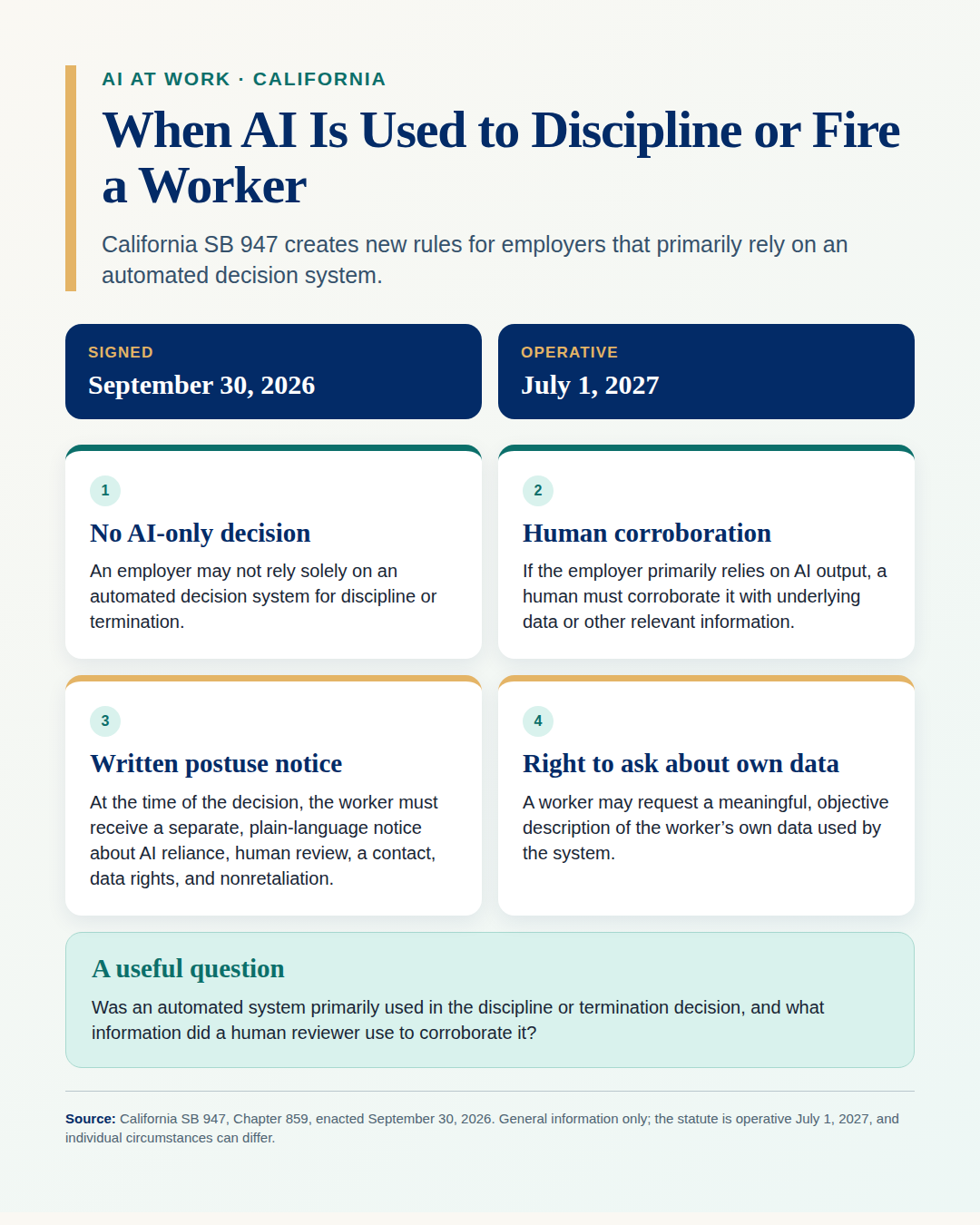
- California SB 947 becomes operative on July 1, 2027. It addresses automated decision systems used in employee discipline and termination.
- An employer may not rely solely on an automated system for a disciplinary or termination decision.
- When an employer primarily relies on automated output, a human must corroborate it using the underlying data or other relevant information.
- Affected employees must receive a separate written postuse notice and may request a meaningful, objective description of their own data used by the system.
This is not a rule against all workplace technology
An automated decision system can be more than a chatbot. Under SB 947, it is a computational process based on machine learning, statistical modeling, data analytics, or artificial intelligence that produces a score, classification, recommendation, or similar simplified output used to assist or replace human judgment and that materially affects people. The law does not treat a calculator, a database, a spam filter, a firewall, or a simple compilation of data as an automated decision system. The statutory definitions are in Labor Code section 1520.
That distinction matters. The new law does not say every employer must abandon software. It addresses a specific risk: a workplace may treat an algorithmic score, prediction, or recommendation as if it were a final judgment about a worker.
The law also has specific coverage exceptions. It does not apply to parties covered by a collective bargaining agreement that clearly and unambiguously waives these provisions, sets out wages or earnings and other terms and conditions of work, and provides protection from algorithmic management. A separate, limited exception covers automated-system use required by, or reasonably necessary to comply with, a federal statute, regulation, or binding federal contract for specified aircraft or national-security, military, space, or defense development. That exception applies only to the covered operations—not every use by a federal contractor. Read the exceptions in Labor Code sections 1526.5 and 1526.6.
Think of the system as a smoke alarm, not a fire marshal. An alarm can point to something worth checking. It cannot, by itself, decide what happened or what consequence is fair. SB 947 requires an employer that primarily relies on the system’s output to have a human corroborate the result before using it for discipline or termination.
A human review must do more than click “approve”
The law says an employer may not rely solely on an automated decision system for discipline or termination. When the employer primarily relies on the system’s output, the employer must direct a human to corroborate the decision with data used to produce the output or with other relevant supporting information.
The statute gives examples of information that can be relevant to corroboration. They include supervisory or managerial evaluations, personnel files, work product, peer reviews, and witness interviews. The point is not that every decision requires each kind of record. The point is that the human review must look beyond an unverified score or recommendation.
SB 947 also sets a clear limit. If the output cannot be corroborated, or if the human reviewer concludes that it is inaccurate, incomplete, or misleading, the employer may not use that output for the disciplinary or termination decision. See Labor Code section 1522.
Workers receive a written notice when AI was primarily used
When an employer primarily relied on an automated decision system for discipline or termination, the employer must provide the affected employee a written postuse notice when it communicates the decision. The notice must be a separate, stand-alone communication, written in plain language, and supplied in the language ordinarily used for routine communications with employees.
The notice must tell the worker four important things.
- The employer primarily relied on an automated decision system in making the decision.
- A human reviewed and corroborated the system’s output.
- The worker can contact a human for more information and may ask for a description of the worker’s own data used by the system.
- The employer may not retaliate because the worker exercises rights under the law.
This is a postuse notice, not a promise that every workplace will explain every technical detail before it deploys a tool. Still, it gives a worker a concrete place to start after a covered disciplinary or termination decision. The required contents appear in Labor Code section 1524.
The right to ask about your own data is narrower than a demand for the entire system
An employee may request a meaningful, objective description of the employee’s own data used by an automated decision system when the employer primarily used the system in a disciplinary or termination decision. That right concerns the worker’s own data. The law also directs employers to protect the personal information of customers, other workers, and other individuals when giving the description.
A useful question is: “Was an automated decision system primarily used in this disciplinary or termination decision, and what information did a human reviewer use to corroborate it?” The answer may help identify whether the new law applies. It does not replace legal advice about an individual situation.
The law also addresses discrimination and retaliation risks
SB 947 prohibits an employer from using an automated decision system to violate labor, occupational-safety, employment, or civil-rights laws. It separately prohibits using the system to infer a worker’s protected status or to predict and take adverse action because a worker exercised legal rights. The law also contains an anti-retaliation provision for employees who use or attempt to use their rights, file a complaint, cooperate in an investigation, or help enforce the law.
Those rules sit alongside existing workplace protections. A technology label does not excuse discrimination, retaliation, or another unlawful employment action. Atlas Law Center’s earlier guide, Fired by Software, explains the broader principle that an employer remains accountable when it uses automated systems to manage workers.
Why this is timely now
Governor Gavin Newsom signed SB 947 on September 30, 2026, as part of a group of workplace AI and surveillance measures. The Governor’s announcement described the new rule as a protection ensuring that real people review automated employment actions. Read the official announcement.
The law does not become operative until July 1, 2027. That lead time matters. Employers can evaluate where automated scores or recommendations appear in discipline and termination workflows. Workers can understand the questions the new law makes relevant. Neither group should assume that the law supplies a simple answer to every technology-assisted employment decision.
Questions addressed
1. Does SB 947 mean AI cannot be used at work?
No. The law does not ban workplace technology generally. It regulates an employer’s use of an automated decision system for employee discipline and termination, including a ban on relying solely on that system for those decisions.
2. When does California SB 947 take effect?
The new provisions become operative July 1, 2027. They were enacted on September 30, 2026.
3. What can a worker ask for after a covered decision?
When an employer primarily used an automated decision system for a disciplinary or termination decision, the employee may request a meaningful, objective description of the employee’s own data used by the system. The written postuse notice must also identify a human contact for more information.
4. Does a human reviewer need to do more than repeat the AI’s recommendation?
Yes. When an employer primarily relies on the system’s output, the law requires human corroboration using the data used to produce the output or other relevant supporting information. The employer may not use the output if it cannot be corroborated or the reviewer finds it inaccurate, incomplete, or misleading.
General information only. This article does not provide legal advice or create an attorney-client relationship. SB 947 is California-specific and becomes operative July 1, 2027. Employment protections and the facts of a workplace decision can vary.
Wondering how this applies to you?
Every situation is different, and deadlines can be short. A free case review helps the intake team identify time-sensitive issues.
Start your free case review