

Nationwide U.S. general information; federal Fair Labor Standards Act baseline only, subject to coverage, exemptions, facts, and state or local law
AI can make output faster without making review disappear
An AI agent can be like a very fast printing press in the next room. It can produce drafts, alerts, and proposed actions at enormous speed. But it cannot make one person able to read, check, correct, and responsibly act on an unlimited pile of material. The printing press can accelerate the pile. The doorway through which the pile must pass is still a human being’s time and attention.
That distinction is becoming more important as workplaces use agents that can do work while an employee handles other tasks. An agent may draft a customer response, compare documents, sort incoming requests, flag a possible issue, create a schedule proposal, or prepare code for review. Those outputs may be useful. They can also create a new layer of work: reviewing what the system produced, deciding whether to rely on it, correcting mistakes, documenting a decision, and responding when the system sends something back for human judgment.
The useful question is not, “How many hours did the AI work?” An AI system’s runtime is not a payroll record. The useful question is, “What human work does the employer expect someone to do because the AI system is running?”
A fresh report shows the review-capacity problem
On October 16, 2026, Anthropic published a report about how AI is changing work inside Anthropic. The study uses the company’s internal data on employment, AI use, output measures, employee surveys, internal communications, calendar data, and hiring records, along with 17 employee interviews. It is a company-specific report about a frontier AI company. It is not a survey of U.S. workers, a national forecast, or proof that every workplace using AI will experience the same changes. Read Anthropic’s report and its methodology.
Anthropic reported that, by August 2026, employee-directed interactive agent runtime exceeded estimated employee work hours by six to one inside the company. It also reported that even nontechnical employees would need half of their workweek to read all output generated by their Claude agents. Anthropic calls some of the surrounding activity “meta-work,” such as building visibility tools and monitoring agent pipelines. Read the full report.
The report’s six-to-one figure has a narrow definition. It counts agent inference and active tool use, excludes waits longer than 30 minutes, and estimates human work hours from headcount using a 40-hour week. It does not measure time cards, employee pay, every form of employee review, or what happens at other companies. Anthropic also says that its employees’ tool adoption was not random and that the company’s rapid business growth was occurring during the same period. Those limits matter. A headline about fast output cannot answer how much review time is appropriate in another workplace.
Still, the report makes a practical point visible. As a tool generates more material, the human job may shift from producing the first draft to deciding what deserves attention, what can be trusted, what needs repair, and what cannot wait until tomorrow.
The work that follows an AI suggestion can still be work
Under the Fair Labor Standards Act, the word “employ” includes “to suffer or permit to work.” The U.S. Department of Labor explains that work not requested but suffered or permitted to be performed must be paid. Its example includes an employee who voluntarily stays after a shift to finish an assigned task or correct errors. Read Department of Labor Fact Sheet #22.
That general rule does not tell every worker whether a particular AI-related task is compensable. Facts matter. An employee who merely has an AI application installed is different from an employee expected to review a queue of agent output, respond to after-hours notifications, correct a generated mistake, or finish an AI-created assignment after clocking out. It also matters what the employer knows or permits, what the employee’s actual duties are, whether the worker is covered and nonexempt, and what state or local law may add.
For employees covered by the FLSA who are not exempt, federal overtime is generally due at not less than one and one-half times the regular rate for hours worked beyond 40 in a workweek. Federal law looks at the workweek, not whether the additional time happened on a weekend, holiday, or an especially busy day. Read Department of Labor Fact Sheet #23.
Being paid a salary does not, by itself, settle exempt status. The Department of Labor says job titles do not determine the answer. Certain exemptions depend on specific salary and duty tests. Read Department of Labor Fact Sheet #17A.
A fast system can quietly stretch a shift
Consider a worker whose schedule ends at 5:00 p.m. At 4:55 p.m., an AI agent produces 20 proposed customer messages and three alerts that need a human response. The technology may have done the drafting quickly. But if the worker is expected to read the messages, correct errors, choose what may be sent, and respond to the alerts, the relevant human task did not end merely because the system produced the material in seconds.
The same question can arise at the beginning of a shift. A worker may arrive to a full queue of AI-generated items that must be reviewed before the ordinary work can start. Or a worker may need to watch an agent’s dashboard while doing another job because the system is expected to escalate decisions rapidly. Whether any particular period counts as hours worked is fact-specific. The core point is simpler: speed on the screen should not erase time on the clock.
The Department of Labor also says that covered employers must keep accurate records of daily and weekly hours worked for each nonexempt worker. A workplace may choose the timekeeping method, but the record must be complete and accurate. For a fixed schedule, the Department says the employer must record actual longer or shorter hours on an exception basis. Read Department of Labor Fact Sheet #21.
Four questions that make hidden review work easier to see
These questions are general workplace questions. They are not legal advice and do not decide whether any person is owed pay or overtime.
- What does the employee have to do after the AI produces an output? The answer may include reading, checking, correcting, approving, forwarding, explaining, or documenting a result. A job description that says “the AI handles it” can hide the human work that makes the output usable.
- When is that review expected to happen? If review has to occur before a customer deadline, before the next shift, or whenever an alert appears, the task may not fit neatly inside a scheduled work period. A clear expectation can prevent a quiet extension of the workday.
- Can a person slow down, defer, or question the system? An AI tool may be productive only when a person has enough time and authority to check it. A review requirement with no time to review is like requiring a quality inspection after the shipment has already left the dock.
- How does the workplace capture actual human time? For covered, nonexempt employees, accurate records matter. The right method depends on the workplace, but a timekeeping process should be able to reflect extra human work instead of treating the AI system’s activity log as a substitute for an employee’s hours.
What this does—and does not—mean
AI can reduce repetitive work. It can also improve the first draft, surface a pattern, or make a routine process easier to manage. This article does not assume that a new AI tool always creates extra hours or that every human review is difficult. The effect depends on the tool, the job, the employer’s expectations, the reliability of the output, and the human authority to pause or correct it.
It also does not mean every employee is entitled to federal overtime. FLSA coverage and exemption questions are specific. State and local wage laws, employment agreements, and collective-bargaining agreements may create different or additional rules. A worker who believes required work is not being accurately recorded should consider preserving the relevant facts and seeking information tailored to the situation.
The strongest AI workflow is not the one that produces the most material. It is the one that lets a human being make a reliable decision without silently turning judgment, checking, and correction into invisible labor.
For an overview of how automated systems can shape workplace discipline and termination, read Fired by Software: Your Rights When an Algorithm Manages and Terminates Workers. For a separate explanation of overtime issues for salaried workers, read Salaried Does Not Mean Exempt: When You Are Still Owed Overtime. For a discussion of how AI may reshape early-career pathways, read AI and the First Rung of Work. These articles address different questions and do not substitute for advice about an individual situation.
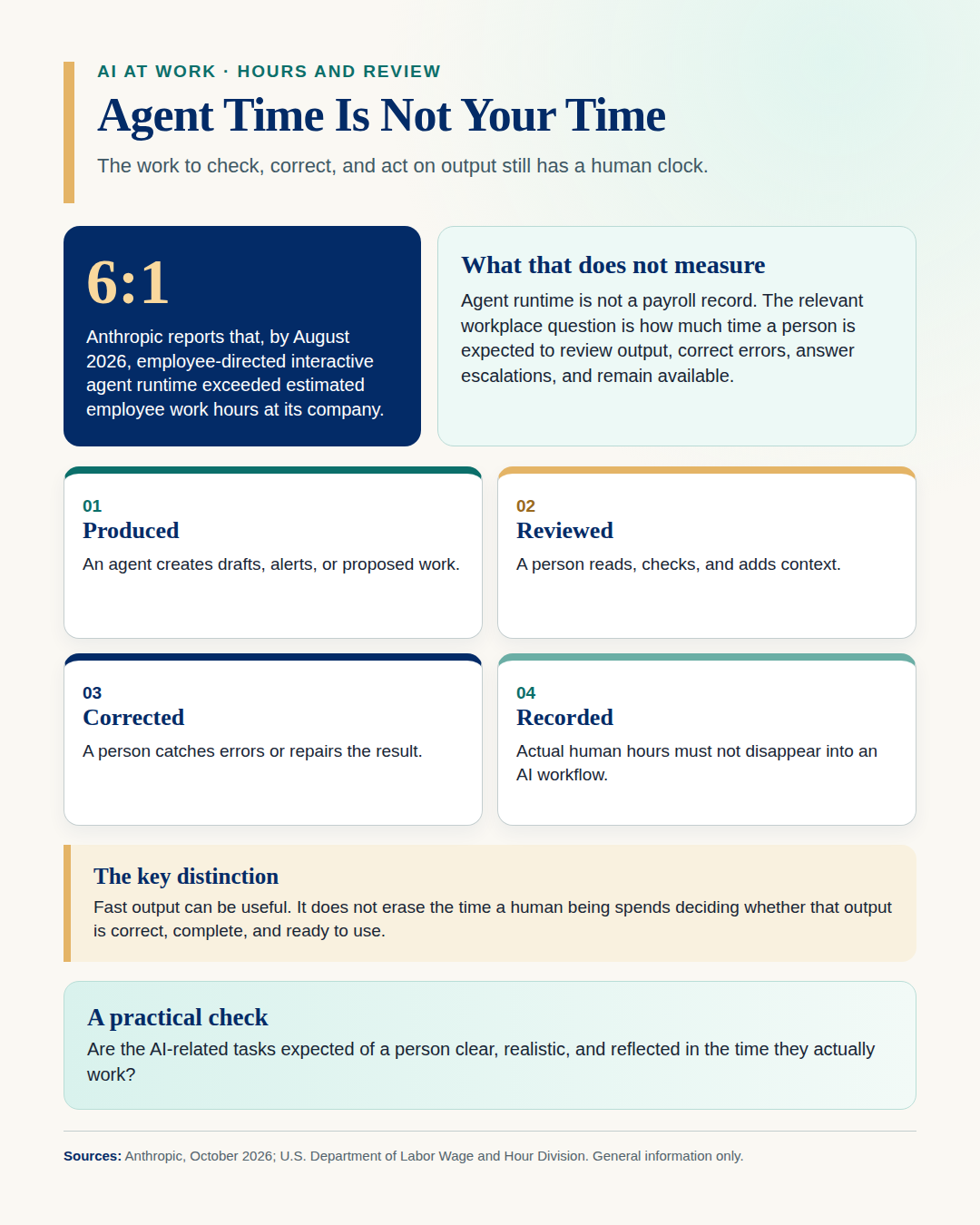
Text version of the infographic
AI AT WORK · HOURS AND REVIEW
Agent Time Is Not Your Time
The work to check, correct, and act on output still has a human clock.
6:1
Anthropic reports that, by August 2026, employee-directed interactive agent runtime exceeded estimated employee work hours at its company.
What that does not measure
Agent runtime is not a payroll record. The relevant workplace question is how much time a person is expected to review output, correct errors, answer escalations, and remain available.
01
Produced
An agent creates drafts, alerts, or proposed work.
02
Reviewed
A person reads, checks, and adds context.
03
Corrected
A person catches errors or repairs the result.
04
Recorded
Actual human hours must not disappear into an AI workflow.
The key distinction
Fast output can be useful. It does not erase the time a human being spends deciding whether that output is correct, complete, and ready to use.
A practical check
Are the AI-related tasks expected of a person clear, realistic, and reflected in the time they actually work?
Sources: Anthropic, October 2026; U.S. Department of Labor Wage and Hour Division. General information only.
Questions addressed
1. Does AI-agent runtime count as an employee’s work time?
No. A system’s runtime is not the same as a person’s hours worked. The relevant question is the human work the employee is expected or permitted to do, such as reviewing output, correcting errors, responding to escalations, or completing related tasks. Whether a particular activity counts as work time depends on the facts and applicable law.
2. Can an employer require a nonexempt employee to review AI output after a shift?
A workplace may set job expectations, but covered nonexempt employees generally must be paid for compensable work time. Under the Fair Labor Standards Act, whether particular review activity counts as hours worked depends on facts such as the task, the employer’s knowledge, the employee’s duties, and the applicable law.
3. Does being salaried mean AI-related extra work never creates an overtime issue?
No. A salary alone does not determine whether a worker is exempt from federal minimum-wage and overtime requirements. Exempt status depends on the requirements of the particular exemption, which can include duties and compensation tests. State or local law may impose different or additional requirements.
4. What should an employee document if AI-related work extends the day?
The relevant details may include what the employee was asked or expected to do, when the work occurred, how long it took, what the AI system produced, and how time was reported. The facts that matter vary by situation. This article is general information, not advice about a claim.
General information only. This article does not provide legal advice or create an attorney-client relationship. It is not an assessment of a particular worker, employer, AI system, timekeeping practice, work schedule, job classification, employment agreement, collective-bargaining agreement, wage record, complaint, or potential claim. Rights, coverage, obligations, and remedies depend on the facts and applicable law.
Wondering how this applies to you?
Every situation is different, and deadlines can be short. A free case review helps the intake team identify time-sensitive issues.
Start your free case review