
Nationwide policy and workplace-practice education
The story is not simply “AI took the jobs”
Software work offers an unusually clear early view of how AI can change a profession. Some evidence points to rising demand. Some points to a narrowing entrance. Both can be true at the same time.
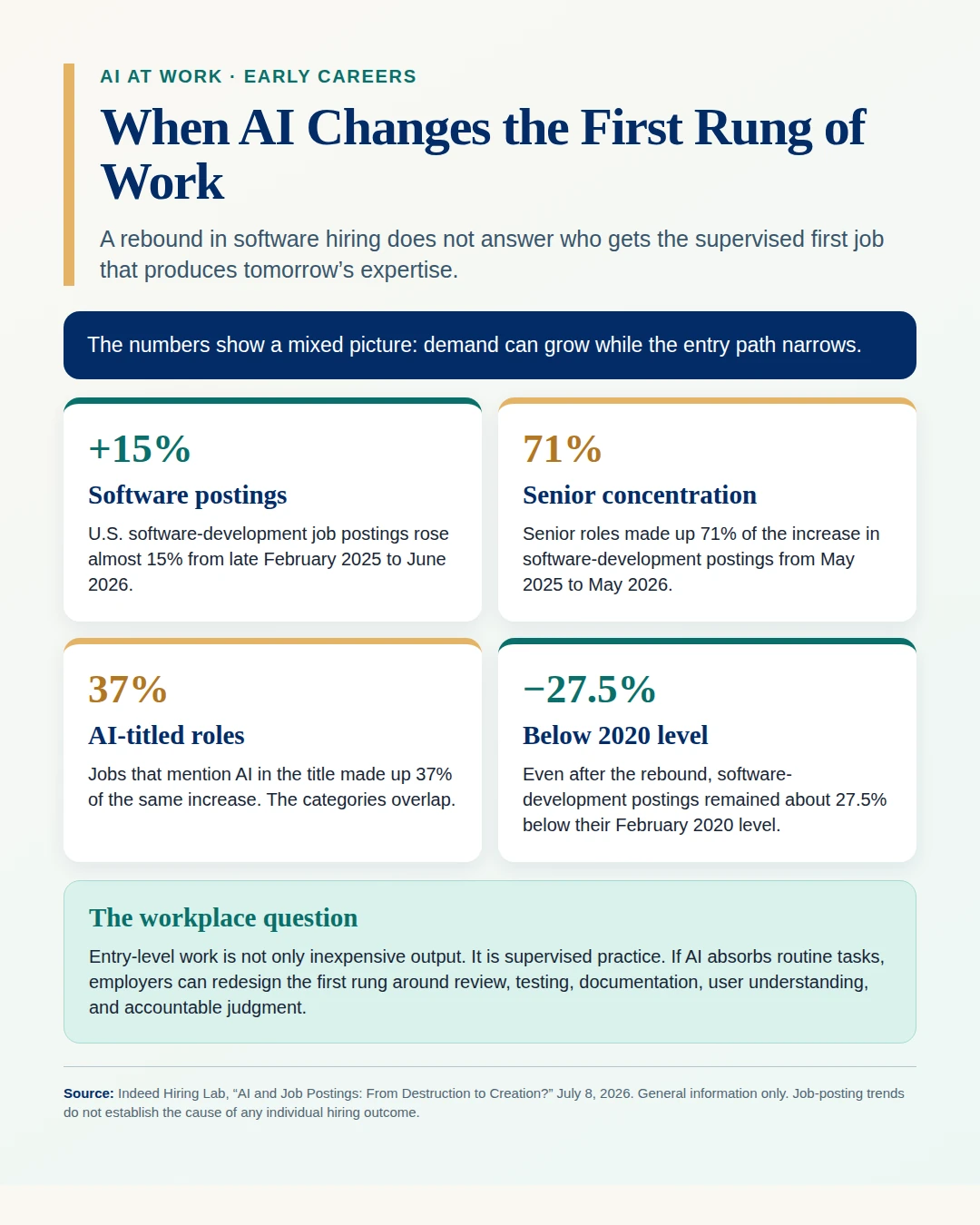
Indeed Hiring Lab reported that U.S. software-development job postings rose almost 15% from late February 2025 to June 2026, even as overall job postings fell 7%. That rebound did not return the field to its earlier level: software-development postings still stood about 27.5% below February 2020. Read the Indeed analysis.
The composition of the rebound matters. Indeed found that senior roles accounted for 71% of the increase in software-development postings from May 2025 to May 2026. Jobs that mention AI in their titles accounted for 37% of the same increase. Those categories overlap, so they should not be added together. Still, they point to a labor market that is rewarding experience and AI fluency more than a broad expansion of traditional entry paths.
Why the first rung matters
Entry-level work is not just inexpensive output. It is where people practice under supervision, learn how a real organization works, receive feedback, and develop judgment before the stakes get higher.
Think of it as the on-ramp to a highway. AI can make the highway faster, but a faster highway does not help someone if the on-ramp disappears. A profession can need more expert workers in the future while still making it harder for people to acquire the experience required to become experts.
This is not only a software problem. Junior work across many fields has often included routine research, first drafts, data cleanup, basic analysis, documentation, and operational follow-through. These are precisely the kinds of tasks that generative AI can speed up or partly automate. The workplace choice is whether that saved time becomes fewer opportunities for newcomers or better-designed opportunities to learn higher-value work.
The early evidence is real, but it does not prove one cause
Stanford researchers say that broad AI-driven job loss is not yet visible across the overall labor market. Their policy brief also identifies a more focused concern: recent graduates face a difficult market, and young workers in AI-exposed occupations may be experiencing greater pressure. Read the Stanford policy brief.
The same Stanford brief is careful about causation. Interest-rate changes, pandemic-era over-hiring, and shifts toward remote work can also affect early-career hiring. The authors describe the direct effect of AI on young-worker demand as an active research question rather than a settled conclusion.
That distinction is important. A weak entry-level market should not be reduced to one explanation. But uncertainty is not a reason to ignore the design problem. If routine junior tasks are changing quickly, the career ladder should be examined before its first rung becomes too thin to use.
A Stanford Digital Economy Lab paper illustrates why this needs continuing measurement. It studies a balanced panel of anonymized ADP payroll data that covers between 3.5 million and 5 million workers per month from January 2021 through June 2026, after the study’s restrictions. The authors say their results are a snapshot, not a forecast, and do not by themselves establish that AI caused the trends. Read the study and its methods.
Automation can change tasks without removing the need for judgment
AI coding tools provide a useful example. Anthropic’s analysis of 500,000 coding-related interactions found that 79% of the reviewed Claude Code interactions involved automation rather than augmentation. That figure does not mean 79% of developer jobs are automated. It describes a particular sample of tool interactions.
Even in that analysis, human involvement remained common. A “feedback loop” pattern, in which a person gives the system error information or other input, appeared frequently. Anthropic also warns that its data reflects early adopters, excludes some types of professional use, and cannot show how people ultimately used AI output in real codebases. Read the research and its limitations.
The lesson is not that entry-level work must stay exactly as it was. It is that a workplace can move routine production to AI while deliberately preserving the human practice that builds reliable judgment.
What a stronger first rung can look like
No general rule gives every worker a legal right to a particular entry-level role or employer-funded career ladder. This is a workplace-practice and policy discussion, not individualized legal advice.
Still, organizations that rely on AI have choices about how people enter the work.
- Design junior roles around supervised judgment. A new worker can review AI output, test it against real requirements, investigate errors, document decisions, and learn how user or client consequences change the right answer.
- Treat review as a skill, not a leftover task. When AI produces a first draft, someone must decide whether it is accurate, safe, complete, and suited to the real problem. That capability grows through guided repetition.
- Make learning part of paid work. A person cannot build professional judgment if every learning task is pushed after hours or measured only against instant output. Atlas Law Center’s AI Training at Work: Who Gets to Keep Up? explains why access to time and support matters when jobs change.
- Track the path into expertise, not only the output of today’s team. A company may reduce short-term task time with AI and still create a long-term shortage if it stops developing the people who will later supervise, improve, and take responsibility for those systems.
Growth and access are different questions
The federal employment outlook also shows why simple predictions can mislead. The Bureau of Labor Statistics projects that computer and mathematical occupations will grow 7.3% from 2025 to 2035, in part because digital tools and AI solutions are spreading across the economy. BLS also cautions that long-term projections contain inherent uncertainty and should be read for direction and relative scale rather than as exact forecasts. Read the BLS projections.
A field can grow overall while access to its first job becomes more unequal. That is the first-rung problem. It is not a prediction that every starter job will vanish. It is a warning that opportunity can narrow before the headline employment number changes.
Atlas Law Center’s AI and the Future of Work: The New Time Divide asks who receives the benefits of AI productivity. The same question applies here. If AI saves time, does that time become more mentoring, better training, and wider access to meaningful work? Or does it become a reason to demand experience from applicants who have been given fewer chances to gain it?
Questions addressed
1. Does AI mean software-developer jobs are disappearing?
No. The available evidence is mixed. Indeed reports a recent rebound in U.S. software-development postings, while the rebound is concentrated in senior and AI-titled roles. Long-term BLS projections also anticipate growth in computer and mathematical occupations. None of those findings guarantees access to an entry-level role.
2. Why can job postings rise while early-career workers struggle?
A posting count does not show who the roles are designed for. Growth can be concentrated in experienced roles, specialized AI roles, or roles that expect candidates to arrive with skills that were once developed in junior positions.
3. Has research proved that AI caused the entry-level hiring problem?
No. Stanford researchers identify evidence of pressure on young workers in AI-exposed occupations, but they also explain that other forces, including interest rates, pandemic-era hiring, and remote-work shifts, can affect hiring. The direct effect of AI remains an active research question.
4. Do workers have a general legal right to an entry-level career ladder?
This article does not identify a general legal right to a particular job or employer-created career ladder. Employment rights depend on the law and facts that apply to a specific situation.
General information only. This article does not provide legal advice or create an attorney-client relationship. Employment conditions, labor-market evidence, and applicable workplace protections can change over time.
Wondering how this applies to you?
Every situation is different, and deadlines can be short. A free case review helps the intake team identify time-sensitive issues.
Start your free case review