
Nationwide policy analysis and general education
When the job changes, training becomes the dividing line
A new AI tool can look simple from a distance. An employer buys a system, turns it on, and announces that work will become faster. But an AI rollout is rarely just a software change. It can alter the tasks that matter, the skills that count, the pace of work, the evidence used in performance reviews, and the number of people needed on a team.
That makes training a workplace fairness issue.
Imagine two workers in the same department. Both are capable. One receives paid time, coaching, a chance to practice with the real tool, and clear information about how the job will change. The other receives a link to a tutorial after hours and a new quota the next morning. If the first worker advances and the second falls behind, the difference was not talent alone. The workplace built a ramp for one person and a wall for the other.
The International Labour Organization reports that AI is creating demand for hybrid skill sets that combine technical, cognitive, and interpersonal abilities. It also warns that older and mid-career workers in administrative and clerical roles, who may be more exposed to displacement, often face barriers to retraining involving time, cost, and digital literacy. Read the ILO brief.
Training is not the same as a login
A workplace does not create meaningful access to AI training merely by giving employees a username and a video library.
Real learning requires time. A worker should not have to choose between meeting today’s workload and preparing for tomorrow’s job. When training is unpaid, squeezed into a lunch break, or assigned after work, it shifts the cost of the business transition onto the person with the least control over it.
Real learning also requires practical support. AI tools do not change every job in the same way. A customer-service worker, a paralegal, a payroll specialist, and a nurse may each need different examples, different safeguards, and different opportunities to ask questions. A generic demonstration can introduce a tool. It cannot reliably prepare someone to use it well in a high-stakes role.
The OECD reports that training and worker consultation are associated with better outcomes for workers when AI is introduced. Its analysis also recognizes that AI can improve productivity and job quality while creating risks that include automation, loss of agency, bias, privacy breaches, and lack of transparency. Read the OECD’s AI and work findings.
That connection matters. Training helps a person use a new tool. Consultation helps the workplace understand what the tool could break. One builds capability. The other builds accountability.
A fair AI rollout begins before the new metric arrives
Workers often learn about a major system change after it has already been designed. The new tool appears. A dashboard follows. Then a manager begins talking about output, rankings, accuracy, response time, or utilization.
A fairer process begins earlier.
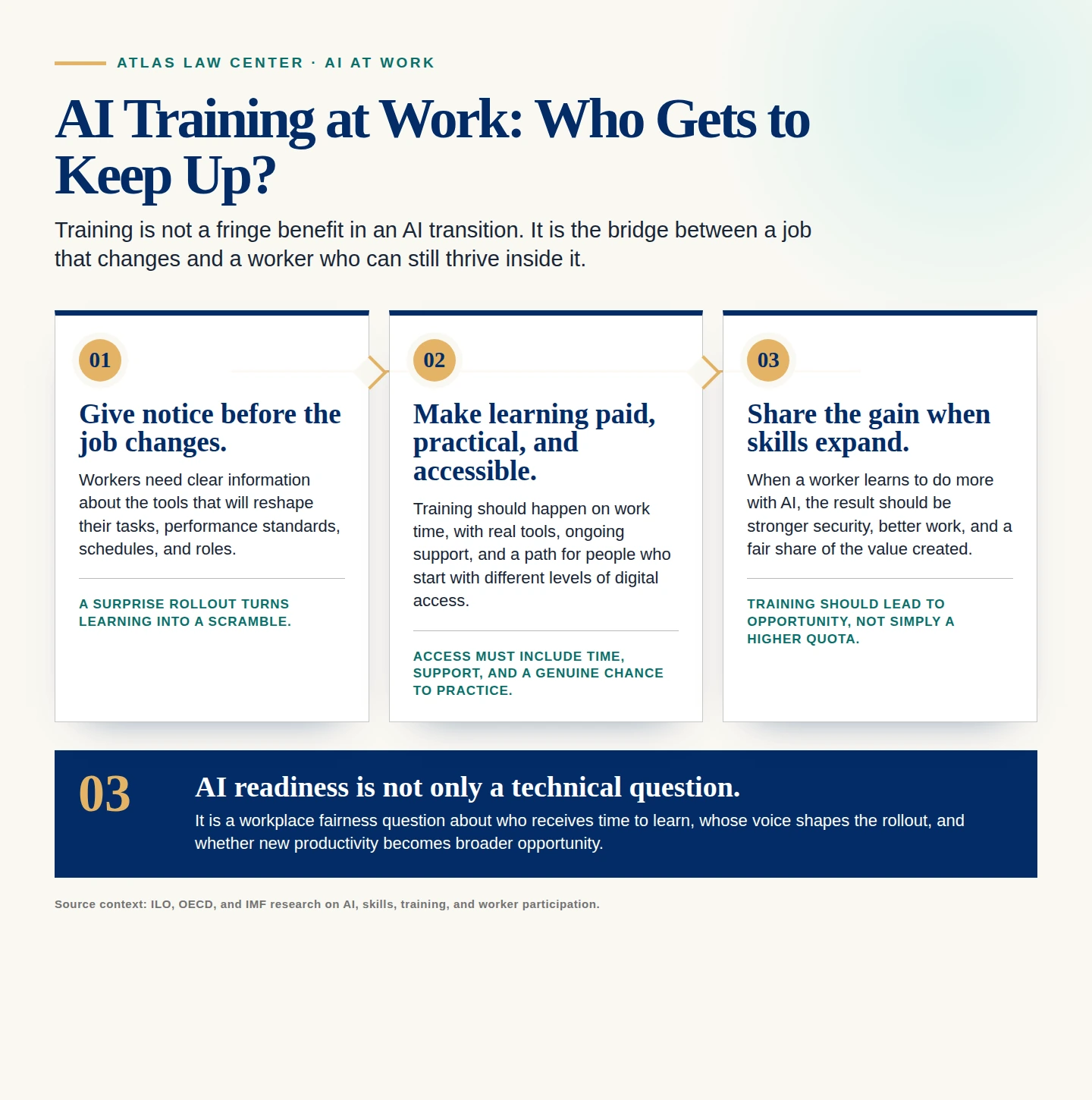
- Give notice before the job changes. Workers deserve clear information about which tasks, performance expectations, schedules, or roles may be affected. Surprise creates fear and prevents thoughtful learning.
- Put learning on paid work time. If the organization will benefit from a worker’s new skills, the organization should make room for the worker to develop them. Paid learning time treats training as part of the job rather than a private expense.
- Make the training practical and accessible. Provide relevant examples, active coaching, room to practice, and alternatives for workers who need accommodations or who have different levels of digital experience.
- Invite worker knowledge into the rollout. The person doing the job can often identify an error, safety risk, privacy concern, or customer harm that is invisible in a vendor demonstration. Worker input is not resistance to innovation. It is a form of quality control.
- Connect new skills to real opportunity. Training should lead to clearer paths to stronger work, more secure jobs, or a fair share of the productivity gains. It should not simply become a way to demand more from the same number of people.
The wider economic stakes
The question is not whether every worker must become an AI engineer. Most people will not. The question is whether people can acquire the skills and judgment their changing roles actually require.
The International Monetary Fund notes that demand for digital and AI-related skills is rising quickly and warns that young people and middle-income workers may face the greatest pressure without large investments in education, reskilling, and lifelong learning. Read the IMF overview.
The risk is that AI becomes a private ladder inside the workplace. A small group gets the new tools, the learning time, and the visibility that lead to advancement. Everyone else is expected to adjust from the ground. Over time, that kind of access gap can become a pay gap, a promotion gap, and a job-security gap.
A better approach recognizes that the human side of AI is not an afterthought. It is the main implementation challenge. Technology does not produce a fair workplace by itself. A fair workplace is built through decisions about time, training, staffing, privacy, accountability, and voice.
How this connects to workers’ rights
This article is a policy and workplace-practice discussion, not a statement that every worker has the same legal right to employer-provided AI training. Employment protections vary by jurisdiction and by the facts of a situation.
But the way an employer introduces AI can still matter legally. Training practices may become relevant when a new system interacts with discrimination, disability accommodation, retaliation, privacy, wage-and-hour rules, or a decision about hiring, discipline, pay, or termination. The analysis depends on the actual facts, the jurisdiction, and the law that applies.
For help understanding automated employment decisions, read Your Rights When AI Makes the Decision. For concerns about AI productivity metrics, read Scored by a Machine. Those articles explain the employment-law context for automated decisions and performance systems in more detail.
Questions addressed
1. Does every worker have a legal right to AI training?
No single rule gives every worker the same right to employer-provided AI training. The applicable law can depend on the jurisdiction, the workplace, the job, and the circumstances. Training practices can nevertheless become important when they affect protected groups, reasonable accommodations, pay, discipline, or access to opportunity.
2. Why should AI training happen on paid time?
When a business adopts AI to change how work is performed, paid time to learn helps ensure that the economic cost of the transition does not fall entirely on workers. It also gives people a realistic chance to use the tool safely and effectively before they are evaluated against new expectations.
3. Can employees ask questions about an AI system before it changes their job?
Employees can ask how a new system will affect their work, what information it uses, what it will measure, and how decisions will be reviewed. The scope of an employer’s legal duties depends on the facts and jurisdiction, but questions raised early can help workers understand the change and preserve a record of what was communicated.
General information only. This article does not provide legal advice or create an attorney-client relationship. Employment protections and AI-related workplace rules vary by jurisdiction and can change over time. Information current through October 11, 2026.
Wondering how this applies to you?
Every situation is different, and deadlines can be short. A free case review helps the intake team identify time-sensitive issues.
Start your free case review