
Nationwide policy analysis and general education
AI productivity is not the same as free time
A recent New York Times Opinion video uses an AI reconstruction of John Maynard Keynes to pose a stark possibility: society could separate into “skilled and overworked professionals with money but no time” and everyone else with “time but no money.” The video is an editorial thought experiment, not a historical statement from Keynes. Its value is the question it forces us to confront: when technology does more of the work, why do so many people expect to work harder? Read the video.
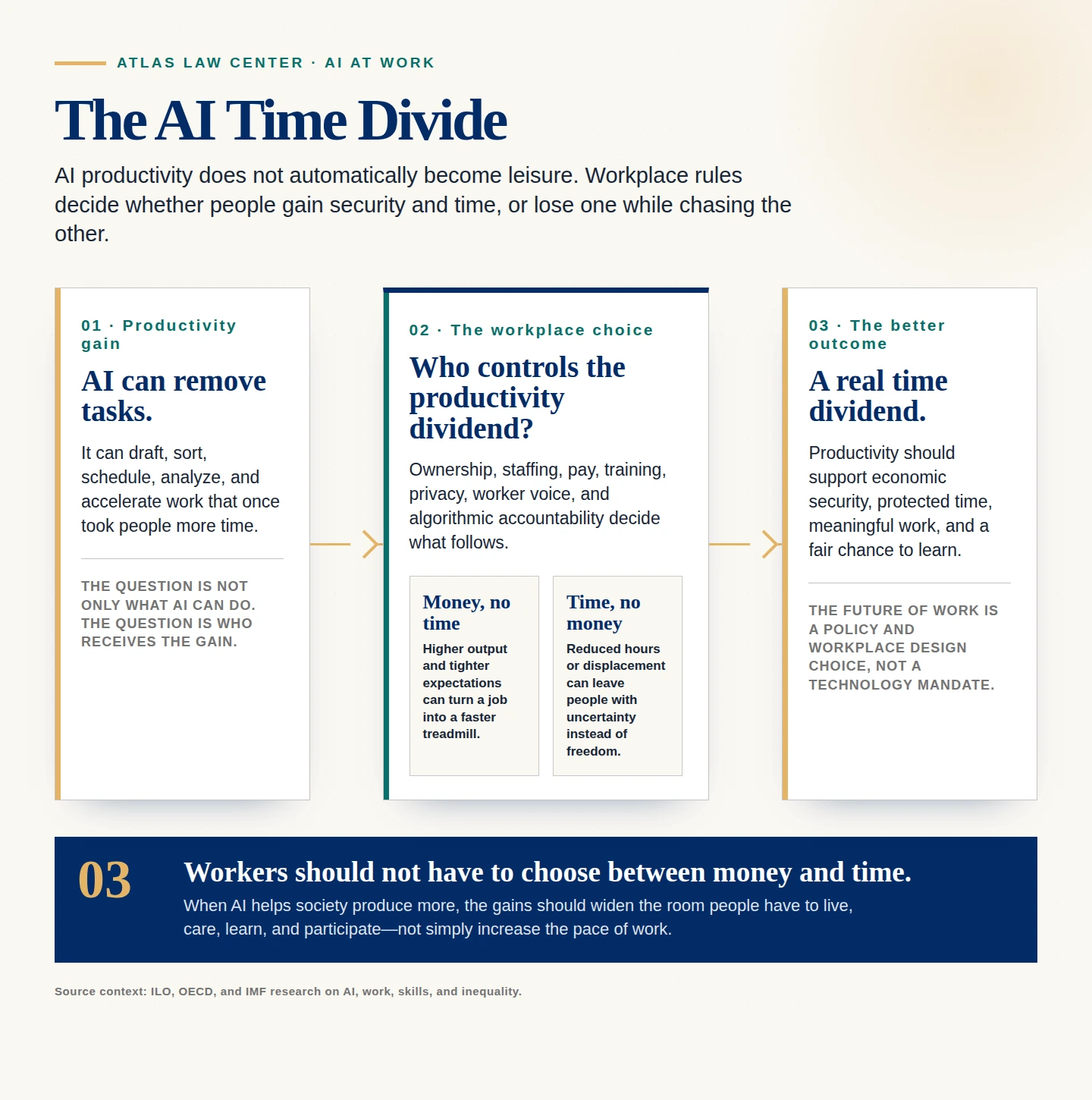
The answer begins with a simple distinction. Productivity is the ability to produce more with the same effort. Free time is the ability to use the saved effort for your own life. Those are not the same thing.
AI is like a powerful moving sidewalk in the middle of the economy. It can help everyone move faster. But if one group owns the sidewalk, sets the entry rules, and decides where the exit leads, the technology can speed up inequality instead of reducing it. The machine is not the full story. The ownership, staffing, pay, training, and accountability rules around it decide who benefits.
The International Labour Organization makes a related distinction between automation and augmentation. Automation removes tasks from human hands. Augmentation helps a person do the job better. The ILO reports that augmentation can create more benefit than automation, but only when workers can access the skills and infrastructure needed to use the technology. Read the ILO brief.
The first side of the divide: money but no time
Some workers may become more valuable because they can direct AI, check its work, handle difficult judgment calls, build trust with clients, or accept responsibility when a system fails. Their income may rise. Their free time may not.
In a poorly designed workplace, AI becomes a faster treadmill. A worker who once managed ten client matters may be asked to manage twenty. A team that once had five people may become three because software handles the first pass. The job remains, but its pace accelerates. The worker keeps the paycheck while losing the space to think, recover, care for family, or simply finish the day without carrying work home.
This is more than a hypothetical concern. In OECD surveys of finance and manufacturing workers, people often reported that AI improved performance and working conditions. Yet workers who experienced AI-related data collection also reported pressure and privacy concerns. In those sectors, 62 percent of finance workers and 56 percent of manufacturing workers said that data collection had increased pressure to perform. Read the OECD’s AI and work findings.
The lesson is not that AI should be rejected. It is that technology that removes one task can be used to remove a burden or to raise a quota. Those are different management choices with different human consequences.
The other side of the divide: time but no money
The second side of the divide is not leisure. It is insecurity.
A person whose hours are reduced, whose role is downgraded, or whose work is scattered into unpredictable assignments may have more unoccupied time. But time without a reliable income is not freedom. Calling it freedom is like calling an empty refrigerator a minimalist kitchen. The space is there, but what matters is missing.
Work also provides more than a paycheck. It can give people routine, social connection, status, and the daily reassurance that someone needs their contribution. A transition that reduces employment without providing real pathways into new work, learning, community, and economic security risks damaging a person’s sense of purpose as well as their budget.
There is no evidence that all jobs are about to disappear. The ILO estimates that 2.3 percent of jobs globally have high automation potential, while the effect of AI on overall employment remains limited to date. But exposure is uneven. Clerical support work is especially exposed, and women are disproportionately represented in some administrative roles at risk of displacement. Read the ILO brief.
That is why the early transition matters. The important question is not only whether a job survives. It is whether the person doing the job gains a credible path to the next version of work.
Who gets the productivity dividend?
The AI debate often stops at one question: will jobs disappear? That matters, but it is too narrow. A more useful question is who gets the productivity dividend when a machine makes work faster.
- Will the worker gain higher pay, more secure hours, paid training, or a shorter workweek? Or will the organization keep the gains while raising expectations?
- Will workers receive notice and a real voice before AI changes job duties, evaluation, compensation, scheduling, or staffing?
- Will people be able to challenge a flawed automated decision about hiring, discipline, pay, or termination? Or will a score become a shield that hides human choices?
- Will data collected from workers be used to improve safety and support? Or will it become an always-on metric for extracting more work?
These are not science-fiction questions. They are questions about workplace design, bargaining power, and public policy.
The IMF warns that whether AI supports broad-based prosperity will depend on how well workers can adapt and on large investments in education, reskilling, and lifelong learning. It identifies fiscal policy and social protection as important parts of the transition. Read the IMF overview.
For workers facing a direct employment decision made with AI, Atlas Law Center’s existing guide, Your Rights When AI Makes the Decision, explains the legal context. For workers dealing with AI performance tracking or productivity scoring, Scored by a Machine addresses why an automated number is not the end of the inquiry.
A fair future includes a time dividend
A better AI future should not be measured only by how much more an economy can produce. It should be measured by whether ordinary people have more control over their lives.
A time dividend means that when technology makes work faster, some of the gain returns to people as real, protected time. It can take the form of predictable schedules, adequate staffing, paid time to learn new tools, stronger privacy protections, and shorter hours without lost pay when productivity truly supports it. It also means maintaining a route to economic security for people whose old tasks no longer support a full-time job.
This does not require choosing between innovation and workers. It requires refusing the false idea that innovation is complete when a model performs well. A model is only one part of the system. The workplace rules around the model decide whether the gain becomes burnout, exclusion, or a more livable life.
AI can help remove dangerous, repetitive, and draining work. It can also help people learn, communicate, and solve problems. But it will not distribute its own benefits. That is work for employers, workers, lawmakers, and the public.
Workers should not have to choose between money and time. In a fair economy, more productive machines should make more room for people to have both.
Questions addressed
1. Will AI replace all jobs?
No evidence shows that AI will eliminate all jobs. The more immediate issue is how AI changes specific tasks, occupations, and bargaining power. Some work may be automated, while other work may be augmented. The outcome for any worker depends on the job, employer practices, available training, and public policy.
2. Can AI make work more stressful?
Yes. AI can improve performance and reduce some burdens, but it can also increase work intensity when employers use it to set higher quotas, reduce staffing, or collect more performance data. The OECD reports that many workers who experienced AI-related data collection felt greater pressure to perform. Read the OECD’s AI and work findings.
3. What is a time dividend?
A time dividend is the idea that productivity gains from technology should give people more usable time, not only more output. It connects AI productivity to protected time, economic security, adequate staffing, paid learning, and human control over work.
General information only. This article does not provide legal advice or create an attorney-client relationship. Employment protections and AI-related workplace rules vary by jurisdiction and can change over time. Information current through October 11, 2026.
Wondering how this applies to you?
Every situation is different, and deadlines can be short. A free case review helps the intake team identify time-sensitive issues.
Start your free case review