
Nationwide workplace-practice education with a limited federal FLSA baseline; international research is not U.S. law
Algorithmic management is software that partly or fully takes over functions such as assigning work, monitoring activity or evaluating performance. It does not always use artificial intelligence. 1 The important question is not simply whether an algorithm is present. It is what the system controls—and where a person can correct it when its picture of the work is incomplete.
Think of a navigation app that begins doing more than suggesting a route. It assigns the destination, measures each stop, rates the driver and uses that rating to decide the next trip. The map has become part of management. That is an analogy, not a description of every workplace system. But it helps explain why a seemingly small measurement can matter far beyond a dashboard.
Algorithmic management starts before a warning or firing
A worker may meet algorithmic management through an ordinary task queue, a shift schedule or a screen showing the next job. Software can decide which customer goes to which worker, issue instructions, track completion and compare activity with a target. Those functions can be useful. They can also change how much discretion a person has while doing the work. 1 2
The OECD’s 2025 research surveyed 6,047 firms with at least 20 employees in six countries, including the United States. Its definition covered software that instructs, monitors or evaluates workers, whether or not it uses AI. The respondents were managers or supervisors. Their reports about benefits are perceptions, not proof that workers experienced better conditions or fairer decisions. Firm-level adoption is not the percentage of workers affected. 1
A separate ILO and European Commission Joint Research Centre study examined logistics and healthcare workplaces in France, Italy, India and South Africa. It described coordination benefits as well as concerns about monitoring, pressure and autonomy in some settings. These were qualitative case studies with access limitations—not a representative survey of U.S. workers or a statement of U.S. law. 2
This article focuses on the ordinary workday: how an assignment becomes a measurement, how a measurement becomes a score and how that score can influence what happens next. Atlas’s separate articles address automated firing and biased performance scores.
A useful measurement can still be an incomplete picture
Imagine a hypothetical warehouse worker whose device counts completed picks. A damaged label requires a careful check. Helping a new colleague takes several minutes. A safety problem stops the next task. The count may show fewer completed picks without showing why.
That does not establish wrongdoing. It shows the difference between a measured signal and the work that produced it. A measure can accurately count one activity while leaving out other important contributions.
If the next assignment depends on that score, an incomplete reading can feed the next decision. A worker might be sent for unnecessary retraining, given a different queue or face a tighter target. These are illustrative possibilities, not findings about a particular employer or claims that every system follows this pattern.
The practical issue is the connection between steps. Collecting a number is one thing. Allowing it to change a person’s workload or opportunities is another. The OECD and ILO/JRC research describe instruction, monitoring and evaluation functions; the four-step illustration below is our explanatory model, not a universal technical architecture. 1 2
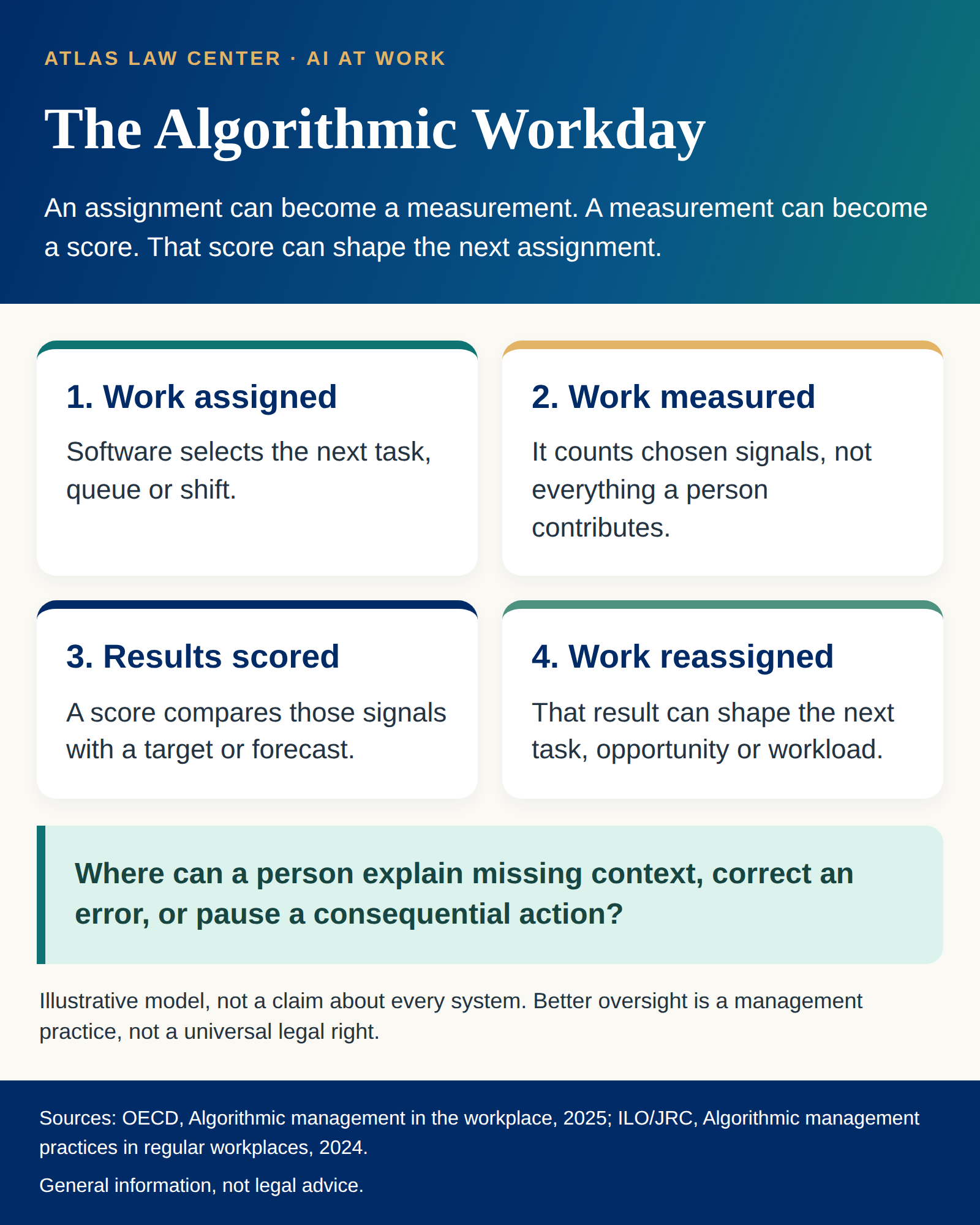
Text version of the infographic
The Algorithmic Workday
An assignment can become a measurement. A measurement can become a score. That score can shape the next assignment.
1. Work assigned
Software selects the next task, queue or shift.
2. Work measured
It counts chosen signals, not everything a person contributes.
3. Results scored
A score compares those signals with a target or forecast.
4. Work reassigned
That result can shape the next task, opportunity or workload.
Where can a person explain missing context, correct an error, or pause a consequential action?
Illustrative model, not a claim about every system. Better oversight is a management practice, not a universal legal right.
Sources: OECD, Algorithmic management in the workplace, 2025; ILO/JRC, Algorithmic management practices in regular workplaces, 2024. 1 2
General information, not legal advice.
Four questions reveal who really controls the system
1. What happens after the system produces an output?
A dashboard that helps a supervisor plan the day is different from a system whose output automatically changes a worker’s next assignment. Ask whether an output is information, a recommendation or an action. The degree of automation and human discretion can differ by workplace and tool. 1 2
2. What work does the measurement leave out?
Does a completion count distinguish an equipment problem from a missed target? Does the system recognize quality checks, handoffs or helping another worker? These are workplace-design questions. A useful measure needs a clear purpose and a way to account for context it cannot see.
3. Who can change the result—not just look at it?
Meaningful oversight requires more than a person being able to open a screen. As a management practice, it means someone has enough information, time and actual authority to investigate an error, correct the underlying data and reconsider a consequential action. The title “human reviewer” does not tell you whether that person can do any of those things.
4. Does a correction reach the next decision?
Correcting yesterday’s score is less helpful if tomorrow’s queue still relies on the old value. Ask how an accepted correction reaches the next assignment and how repeated errors are noticed. This is a practical governance recommendation, not a claim that every worker has a nationwide legal right to a particular appeal process or software explanation.
A productivity score is not the same as hours worked
A count of clicks, scans or completed tasks is a measure of selected activity. It is not, by itself, a determination of compensable time under the Fair Labor Standards Act. The Department of Labor’s Fact Sheet 22 explains that work an employer suffers or permits can count as hours worked, including finishing a task or correcting errors. Waiting time and meal periods depend on their circumstances. 3
The federal baseline depends on coverage, exemptions and the actual facts. State or local law and applicable agreements may add requirements. 4 5 The fact sheet is agency guidance about existing law, not a new AI-specific statute. A low activity score alone does not resolve whether time must be paid. 3
For a separate discussion of the human time spent checking AI-generated work, read When AI Speeds Up, Your Time Still Counts.
The point is better management, not a prettier dashboard
Algorithmic management is not automatically harmful, and a human-made decision is not automatically sound. The research describes systems used for useful coordination as well as workplace concerns. Outcomes depend on the tool, its use and the surrounding workplace arrangements. 1 2
The useful test is what happens when the system misses something important. Can the people responsible see the gap? Can they fix it before the next decision repeats it? A system earns trust through that response—not through the confidence of its score.
For general workplace education, begin with the task, the measurement and the consequence. For advice about a particular pay issue, employment decision or other legal concern, speak privately with a qualified attorney. Do not post workplace documents or personal facts in a public comment or search tool.
References
- OECD, Algorithmic management in the workplace: New evidence from an OECD employer survey, OECD Artificial Intelligence Papers No. 31, February 6, 2025. Read the OECD research.
- ILO and European Commission Joint Research Centre, Algorithmic Management practices in regular workplaces: case studies in logistics and healthcare, February 19, 2024. Read the ILO/JRC report.
- U.S. Department of Labor, Wage and Hour Division, Fact Sheet 22: Hours Worked Under the Fair Labor Standards Act, revised July 2008; source checked October 24, 2026. Read the federal hours-worked guidance.
- U.S. Department of Labor, Wage and Hour Division, Handy Reference Guide to the Fair Labor Standards Act, revised November 2023; source checked October 24, 2026. Read the federal coverage and exemption guide.
- U.S. Department of Labor, Wage and Hour Division, Fact Sheet 17A: Exemption for Executive, Administrative, Professional, Computer & Outside Sales Employees Under the Fair Labor Standards Act, revised September 2019; source checked October 24, 2026. Read the exemption and other-law/CBA guidance.
Questions addressed
1. What is algorithmic management?
Algorithmic management is software that partly or fully automates managerial functions such as assigning work, monitoring activity or evaluating performance. What it controls, and how much discretion people retain, depends on the tool and workplace.
2. Does algorithmic management always use AI?
No. Algorithmic management does not always use artificial intelligence. The OECD’s research definition includes tools that instruct, monitor or evaluate workers whether or not they use AI.
3. Is a productivity score the same as hours worked?
No. A productivity score measures selected activity. It does not by itself determine compensable time under the Fair Labor Standards Act. Coverage, exemptions, actual facts, state or local law and applicable agreements can affect the answer.
4. What makes human oversight meaningful?
As a management practice, meaningful oversight gives a person enough information, time and authority to investigate an error, correct the data and reconsider a consequential action. This is not a statement that every worker has a nationwide legal right to a particular review process.
This article provides nationwide general information about workplace practices and a limited federal wage-hour baseline. International research is identified as research, not U.S. law. It is not legal advice and does not create an attorney-client relationship. Coverage, exemptions, obligations and remedies depend on the facts and applicable law. State or local law and applicable agreements may impose different or additional requirements. Laws and guidance can change.
Wondering how this applies to you?
Every situation is different, and deadlines can be short. A free case review helps the intake team identify time-sensitive issues.
Start your free case review