
California-specific general legal information
California has drawn a new line around emotion AI
On September 30, 2026, Governor Gavin Newsom signed Assembly Bill 1883. The bill became Chapter 853 of the Statutes of 2026 and added Labor Code sections 1580 through 1583. Read the chaptered statute. Confirm the bill history.
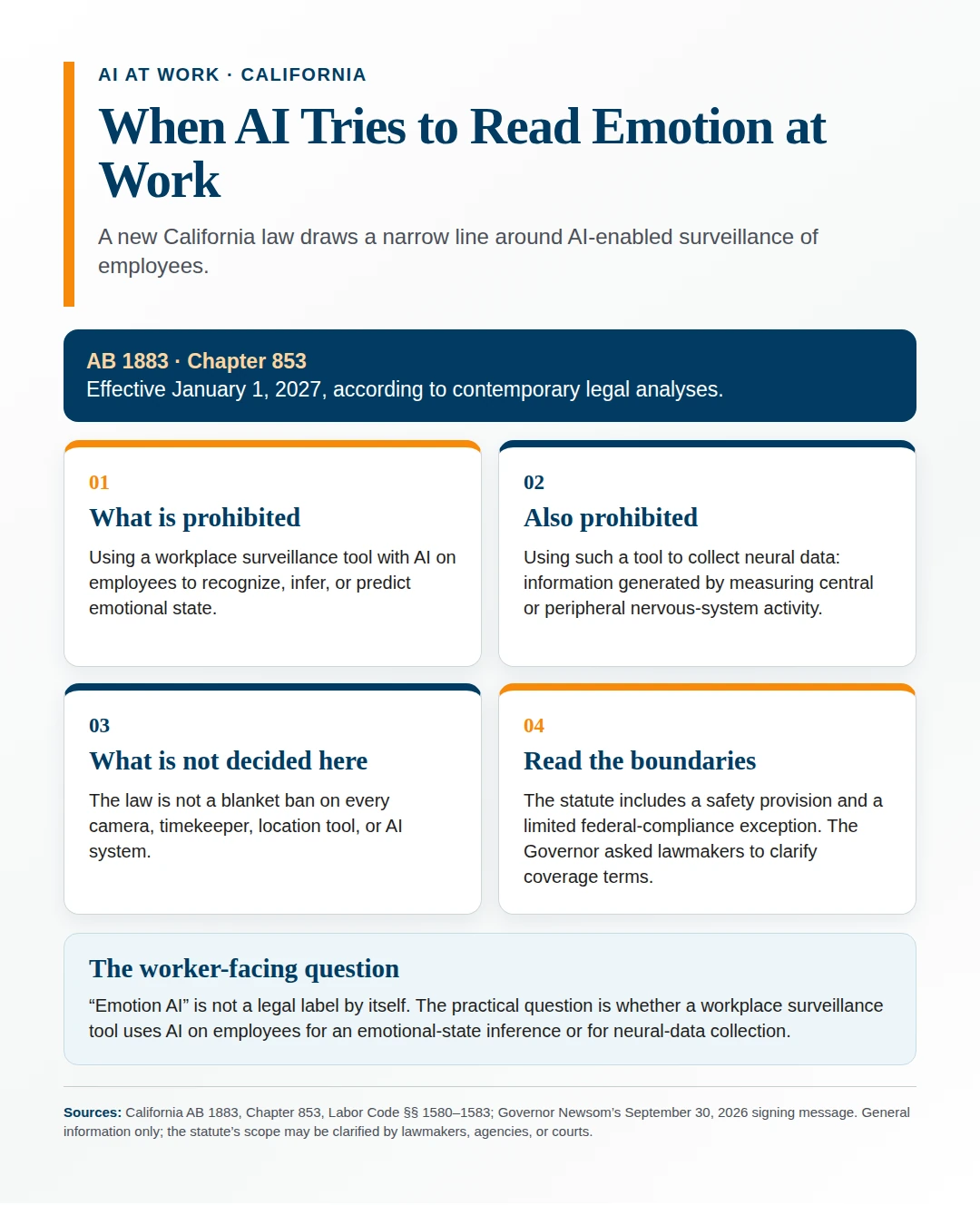
The key rule is specific. Labor Code section 1581 says an employer may not use a workplace surveillance tool that uses artificial intelligence on employees to do either of two things.
- Recognize, infer, or predict an individual’s emotional state.
- Collect neural data.
Contemporary analyses describe the law as taking effect on January 1, 2027. Read a current legal summary. The point is not that every workplace technology will be unlawful. The point is that California has created a focused limit on turning employee data into AI-driven conclusions about how an individual feels or on collecting the defined nervous-system information.
What counts as a workplace surveillance tool?
The statute uses a broad functional definition. A workplace surveillance tool is a system, application, instrument, or device that collects or helps collect employee data, activities, communications, actions, biometrics, or behaviors by a means other than direct human observation.
The law lists video and audio surveillance, continuous incremental time-tracking tools, geolocation, electromagnetic tracking, and photoelectronic tracking as examples. The list is not exhaustive. Read the definitions in Labor Code section 1580.
That means the legal question is not limited to a camera pointed at a desk. It can involve the combination of a surveillance tool, AI, and the particular purpose for which the tool is used. A program that records a call, for example, is not automatically the same thing as a program used to generate an AI conclusion about the employee’s mood, stress, or emotional state.
Think of the distinction as the difference between a thermometer and a claim about why someone has a fever. One records information. The other makes an inference about a person. AB 1883 is directed at a narrow set of AI-powered inferences and neural-data collection, not every form of workplace observation.
What is neural data under the new law?
The statute defines neural data as information generated by measuring activity of an employee’s central or peripheral nervous system that is not inferred from nonneural information. Read the statutory definition.
That definition is specific: it includes measured activity of the central or peripheral nervous system, but excludes information inferred from nonneural information. The law does not require a device to make a final employment decision before the collection prohibition is relevant. It describes collection of neural data as a prohibited purpose when the other statutory conditions are met.
The Governor’s signing message recognized that workplace-surveillance technology is becoming more sophisticated and that employees can be vulnerable to manipulative or abusive use of granular personal information. At the same time, the message says AB 1883 lacks key definitions that may create confusion about which tools are covered and asks the Legislature to refine the measure. Read the official signing message.
The law does not ban every camera, clock, or safety tool
AB 1883 is not a general ban on employee monitoring, ordinary timekeeping, or all AI use at work. Section 1581 includes a safety provision. It says the section does not prohibit an employer from using a workplace surveillance tool to ensure safety, or otherwise if the tool does not meet the specifications in the prohibited-use provision.
The statute also creates a separate, limited exception for certain operations involving aircraft development or national-security, military, space, or defense products or services. That exception applies only when use of the tool is reasonably necessary to comply with a federal statute, regulation, or binding federal contract. Read Labor Code section 1583.
The practical boundaries of the safety wording and some coverage terms may need clarification from lawmakers, agencies, or courts. The responsible answer is not to assume that every safety label removes the rule, or that every technology with AI is covered. The tool, its features, its actual use, and the law’s developing interpretation all matter.
Why this update matters to workers
Workers often encounter monitoring systems through ordinary tools: a platform used to schedule shifts, a call-center dashboard, location technology, a productivity application, or a company-required device. A product name by itself cannot answer whether AB 1883 applies.
Starting in 2027, a useful general question for a California employee will be: is a workplace surveillance tool using AI to make an emotional-state inference about me or to collect neural data? That is different from asking only whether the employer monitors work.
Workers who have questions about a particular system can preserve lawful copies of the policy, notices, screenshots, and communications that describe how the system is used. This article does not ask readers to upload workplace materials. A qualified attorney can assess facts, other applicable laws, and any deadlines in a private setting.
For the broader employment-law context, read Watched at Work: What Employee Monitoring and AI Surveillance Can and Cannot Do. For a discussion of AI performance systems, read Scored by a Machine: Challenging Biased AI Performance and Productivity Systems. Those pages address different questions and do not replace California-specific advice about AB 1883.
The date and the limits matter
AB 1883 is an enacted California statute, not a general nationwide rule. It will take effect January 1, 2027. Its express prohibition speaks to an AI-enabled workplace surveillance tool used on employees for emotional-state recognition, inference, or prediction, or for neural-data collection.
The text defines an employee as a person employed by an employer and does not expressly name external job applicants. That does not resolve every question about applicants, internal candidates, contractors, or other workplace protections. Facts and other laws can matter.
The basic takeaway is clear even while particular questions remain. California has said that AI-enabled workplace surveillance should not be used to turn employee behavior, communications, or biological signals into prohibited emotion conclusions or neural-data collection. As the effective date approaches, the exact scope will remain important.
Questions addressed
1. Can my employer use AI to tell if I sound stressed at work?
Beginning January 1, 2027, California AB 1883 prohibits an employer from using a workplace surveillance tool that uses AI on employees to recognize, infer, or predict an individual’s emotional state. Whether a specific system fits the statutory definition depends on its features and how it is used. The statute includes a safety provision and a limited federal-compliance exception, whose application depends on the particular use.
2. Does the new law ban workplace cameras or timekeeping systems?
No. AB 1883 does not ban every camera, timekeeping system, or workplace technology. Its restriction is focused on using a workplace surveillance tool with AI on employees for emotional-state inference or prediction, or for collecting neural data. The law also includes a safety provision and a limited federal-compliance exception.
3. What is neural data under AB 1883?
The statute defines neural data as information generated by measuring activity of an employee’s central or peripheral nervous system that is not inferred from nonneural information. The law prohibits collecting that defined data with a workplace surveillance tool that uses AI on employees, beginning January 1, 2027. The statute includes a safety provision and a limited federal-compliance exception, whose application depends on the particular use.
4. Does AB 1883 apply to job applicants?
The statute’s express prohibition applies to a workplace surveillance tool that uses AI on employees, and it defines an employee as a person employed by an employer. The text does not expressly name external job applicants. Other laws and the facts of a specific hiring process may still matter.
General information only. This article does not provide legal advice or create an attorney-client relationship. AB 1883 is California-specific; its scope and the rules governing workplace technology can change through legislation, agency action, or court decisions.
Wondering how this applies to you?
Every situation is different, and deadlines can be short. A free case review helps the intake team identify time-sensitive issues.
Start your free case review