
The law is Colorado-specific. It is not a nationwide rule for every employer or worker.
The new law does not make every workplace tool a covered AI system. It does not guarantee that a pay or employment result will be changed. It does not create a new private right to sue. What it does provide is a defined way, in certain Colorado situations, to seek instructions for correcting factually incorrect or materially inaccurate personal data and to request an opportunity for meaningful human review and reconsideration. Read the enacted Colorado law.
Start with the decision, not the buzzword
Colorado Senate Bill 26-189 uses the term “automated decision-making technology,” or ADMT. The definition is broad enough to include technology that processes personal data and uses computation to generate a prediction, recommendation, classification, ranking, score, or other information used to make, guide, or assist a decision about an individual. But a tool is covered only when it materially influences a consequential decision.
That phrase matters. Under the statute, the output must be a non-de-minimis factor used in the decision, and it must affect the outcome by constraining, ranking, scoring, recommending, classifying, or otherwise meaningfully altering how the decision is made. Incidental, trivial, and clerical uses are outside that definition. The law also excludes low-stakes or routine processes that do not materially influence an important opportunity, including examples such as routine scheduling, administrative routing, communication of decisions, and workflow management. The actual tool, decision, and role of the output matter. See the Colorado General Assembly’s enacted-bill summary.
Employment is one of the statute’s covered domains. Its definition of “consumer” includes an employee, a Colorado-resident job applicant, and an individual whose opportunity in Colorado is evaluated in a consequential decision by a person doing business in Colorado. The law is Colorado-specific. It is not a nationwide rule for every employer or worker.
For a broader explanation of how software can assign, measure, and score work, read Algorithmic Management: Who Controls Your Workday?. That article discusses workplace practice. This article explains a new Colorado process that begins only after the statutory coverage tests are met.
What can count as an adverse employment or pay outcome?
The law’s definition reaches more than a formal termination. It includes a decision that denies, terminates, revokes, materially reduces, or restricts access to, eligibility for, selection for, compensation for, or provision of an opportunity or service. It also covers certain materially less favorable differentiated compensation or material terms.
That does not mean every disappointing result qualifies. The decision must be a consequential decision, a covered ADMT must materially influence it, and the outcome must meet the statutory definition. These are fact-specific questions. A worker should not assume that a dashboard, scheduling tool, or ordinary spreadsheet is automatically covered simply because it uses software or produces a number.
Notice before covered use and after an adverse outcome
Before using covered ADMT to materially influence a consequential decision, the deployer must give clear and conspicuous notice that covered ADMT was or will be used and instructions for obtaining the additional information described in the law. A prominent public notice reasonably accessible at points of consumer interaction can satisfy this pre-use duty.
If a covered ADMT materially influences a consequential decision that results in an adverse outcome, the deployer must provide additional information within 30 days after making the decision. The statute calls for a plain-language description of the decision and the role the covered ADMT played.
This post-adverse-outcome disclosure must also provide a simple process for requesting additional information about the system and inputs. That can include the system’s name, its version when applicable, its developer, and the types, categories, and sources of personal data used, to the extent the deployer receives the needed information from the developer. It must also explain the consumer rights in the law and how to exercise them.
The statute protects trade secrets and other information protected by law. A request for information is not a right to obtain proprietary source code, model weights, or every confidential detail. The point is to give a person enough understandable information to use the process the law creates, not to make a private model fully public.
The correction request is about factual data, not every score
The law lets a person request instructions for requesting personal data and correcting factually incorrect or materially inaccurate personal data used in the covered decision. This is a focused safeguard. It is not a command to correct an employer’s opinion, prediction, score, or protected evaluation. The statute expressly says that its correction provision does not require correction of those categories.
That boundary is useful in plain language. A wrong date of hire, mistaken job code, misattributed attendance record, or inaccurate credential entry is different from a disagreement with a forecast or an evaluation. The law does not settle every hard question about where that line falls. It creates a process that can bring the underlying data into view and identify what a person is actually asking to correct.
A simple practical record can help someone understand the issue without posting private workplace material publicly. Keep lawful copies of the decision notice, the date it was received, the information the employer identifies as used, and any factual record that may be inaccurate. Do not upload internal work files, medical information, or personal records to a public comment, public search tool, or general AI tool.
A human reviewer must be able to do more than watch the screen
Colorado’s definition of meaningful human review is unusually concrete. The reviewer must be designated by the deployer and have authority to approve, modify, or override the consequential decision. The reviewer must consider relevant, available primary evidence, be trained to conduct the review, and not default to the system output.
The reviewer must also have enough information to understand the output’s intended use, material limitations, categories of inputs, and principal factors used to generate the output. The statute does not require disclosure of proprietary source code, model weights, or other trade secrets.
The opportunity for meaningful human review and reconsideration is qualified by the phrase “to the extent commercially reasonable.” That phrase is a limit, not a detail to skip. The statute does not promise that every request will lead to a new decision or that a reviewer must agree with the person who asks for reconsideration.
For a broader discussion of existing employment protections when automated systems are used, read Your Rights When AI Makes the Decision: A Worker’s Guide to Automated Employment Decisions. The EEOC also explains that federal employment discrimination laws can apply when AI is used in workplace decisions, including promotion or pay decisions. Colorado’s new statute is a separate state-law process; it does not decide whether a particular situation is discrimination or establish a federal claim. Read the EEOC’s worker guide.
The law is enacted, but the implementation details are still moving
The Colorado Attorney General was directed to adopt rules that clarify and implement the post-adverse-outcome disclosure and human-review provisions by January 1, 2027. The Attorney General’s public page says that the Office held a formal rulemaking hearing on October 26, 2026 and is drafting final rules after considering comments.
As of the sources checked for this article on October 28, 2026, the Attorney General’s page displays proposed and interim materials, not a final published rule set. The enacted statute is the authority for the rights and duties described here. Interim draft language may help explain questions under consideration, but it is not a final obligation and is not treated as one in this article. Follow the Colorado Attorney General’s official rulemaking page.
What this Colorado law does not do
The statute does not apply to every use of a chatbot, spreadsheet, workflow tool, or workplace analytics product. It does not make a human reviewer a guarantee of reversal. It does not create a new private right of action. The disclosure and consumer-rights provisions are enforced exclusively by the Colorado Attorney General, and the statute includes a generally applicable cure process before January 1, 2030 when a cure is deemed possible.
The law also does not erase other rules. It says that compliance does not excuse noncompliance with another applicable law, and that it does not limit or reduce existing state or federal rights or remedies. A specific situation can involve contracts, collective-bargaining agreements, wage law, discrimination law, privacy law, or other state and local rules not resolved by this general explanation.
A map for a new kind of workplace record
Colorado’s approach does not treat an automated recommendation as either magic or meaningless. It asks a more useful question: if a system helped produce an important employment or pay outcome, can a person identify the data at issue and reach a reviewer with real authority to consider it?
Starting January 1, 2027, the answer may be yes in a defined set of Colorado cases. The details matter. A person facing a real employment, pay, or discrimination concern should seek qualified advice about the facts, the correct jurisdiction, and any applicable deadlines.
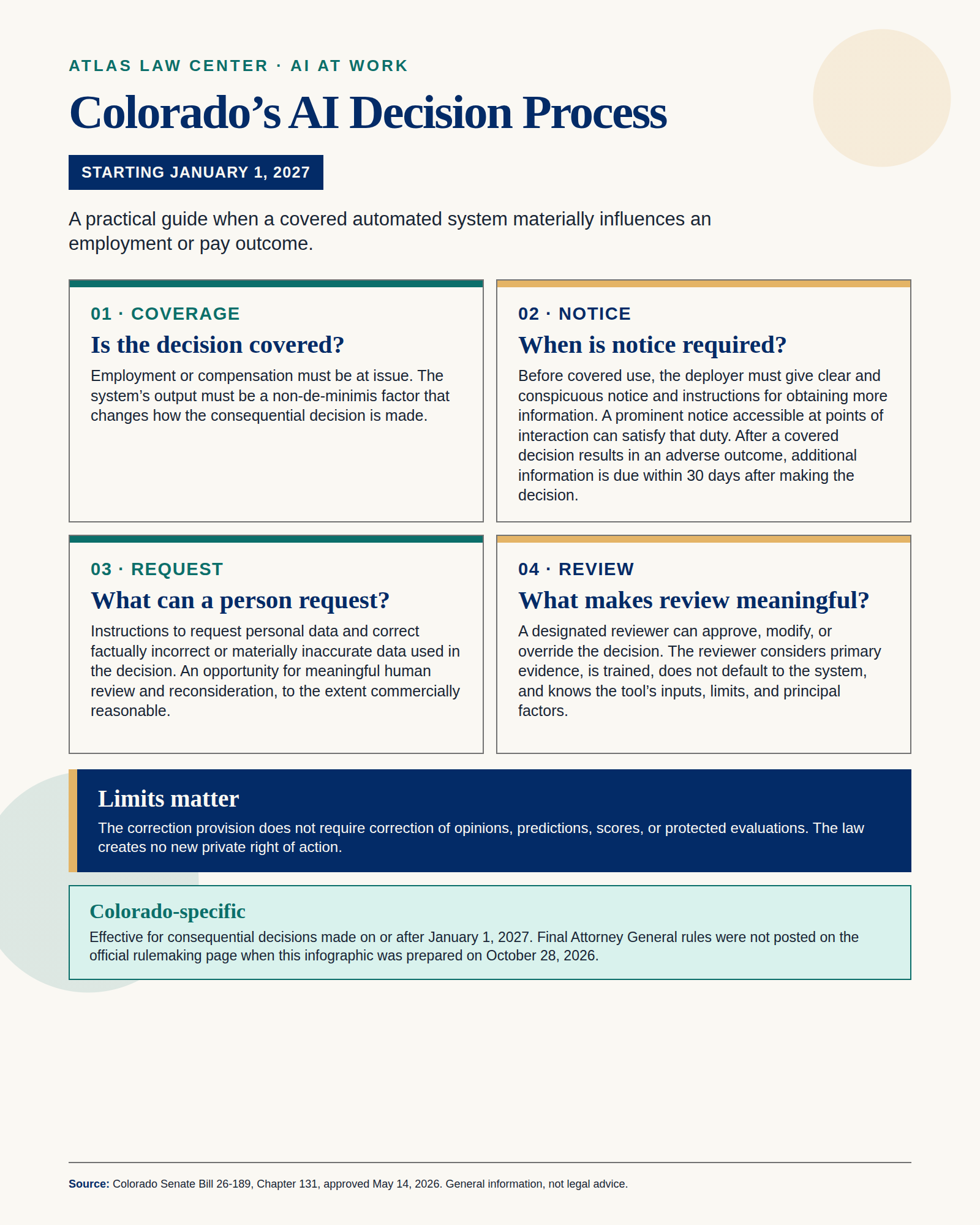
Text version of the infographic
ATLAS LAW CENTER · AI AT WORK
Colorado’s AI Decision Process
Starting January 1, 2027
A practical guide when a covered automated system materially influences an employment or pay outcome.
01 · COVERAGE
Is the decision covered?
Employment or compensation must be at issue. The system’s output must be a non-de-minimis factor that changes how the consequential decision is made.
02 · NOTICE
When is notice required?
Before covered use, the deployer must give clear and conspicuous notice and instructions for obtaining more information. A prominent notice accessible at points of interaction can satisfy that duty. After a covered decision results in an adverse outcome, additional information is due within 30 days after making the decision.
03 · REQUEST
What can a person request?
Instructions to request personal data and correct factually incorrect or materially inaccurate data used in the decision. An opportunity for meaningful human review and reconsideration, to the extent commercially reasonable.
04 · REVIEW
What makes review meaningful?
A designated reviewer can approve, modify, or override the decision. The reviewer considers primary evidence, is trained, does not default to the system, and knows the tool’s inputs, limits, and principal factors.
Limits matter
The correction provision does not require correction of opinions, predictions, scores, or protected evaluations. The law creates no new private right of action.
Colorado-specific
Effective for consequential decisions made on or after January 1, 2027. Final Attorney General rules were not posted on the official rulemaking page when this infographic was prepared on October 28, 2026.
Source: Colorado Senate Bill 26-189, Chapter 131, approved May 14, 2026. General information, not legal advice.
Questions addressed
1. Does Colorado’s new AI decision law apply to every workplace tool?
No. The law applies only when covered automated decision-making technology materially influences a consequential decision. The output must be a non-de-minimis factor and must meaningfully affect the outcome. Incidental, trivial, clerical, and certain low-stakes or routine uses are outside the definition.
2. If AI influences a pay or employment outcome, can I request correction of bad data?
In a covered Colorado situation resulting in an adverse outcome, a person may request instructions for requesting personal data and correcting factually incorrect or materially inaccurate personal data used in the decision. The correction provision does not require correction of opinions, predictions, scores, or protected evaluations.
3. What does meaningful human review mean under the Colorado law?
It means review by a designated individual with authority to approve, modify, or override the decision. The reviewer must consider relevant available primary evidence, be trained, not default to the system output, and have sufficient information about the system’s intended use, limitations, inputs, and principal factors. The opportunity for review and reconsideration is limited to what is commercially reasonable.
4. Can I bring a new private lawsuit under this law?
No. The law creates no new private right of action. Its disclosure and consumer-rights provisions are enforced exclusively by the Colorado Attorney General. Existing rights or remedies under other applicable state or federal law are not reduced by the statute.
This page provides general information, not legal advice, and does not create an attorney-client relationship. Laws, agency guidance, final rules, coverage, exceptions, deadlines, and remedies can change. Colorado’s statute is jurisdiction-specific and takes effect for consequential decisions made on or after January 1, 2027. A particular employment or pay concern can turn on facts and laws not addressed here. Do not post personal facts, private work documents, medical information, or confidential records in a public comment or general AI tool.
Wondering how this applies to you?
Every situation is different, and deadlines can be short. A free case review helps the intake team identify time-sensitive issues.
Start your free case review