
New York legislative-policy analysis with limited discussion of existing New York Labor Law §740. Not a new federal or Illinois rule, and not a finding that a particular worker or company is covered.
The new proposal focuses on the person who speaks up
A worker can understand an AI system well enough to spot a serious problem and still be uncertain about reporting it. A confidentiality policy, a supervisor’s reaction or a confusing notice can make that uncertainty worse. The practical employment question is not only whether an AI model is safe. It is whether a person can raise a qualifying concern through the channels the law protects.
New York Senate bill S10731 was introduced and referred to the Senate Rules Committee on October 28. Senator Andrew Gounardes announced the broader proposal, called “RAISE Act 2.0,” on October 29. As checked November 3, the bill remained in committee. Its proposed whistleblower section is not enacted law. Read the official bill and status. Read the sponsor’s announcement.
The proposal’s broader model-safety provisions are outside this article’s focus. The worker-facing change is in proposed General Business Law §1426: additional anti-silencing and rights-notice provisions tied to existing Labor Law §740. Read proposed §1426 in the bill.
Existing rights and proposed additions are different layers
New York Labor Law §740 already prohibits specified retaliation. Its protected activities include qualifying disclosures or threats to disclose to a supervisor or public body, providing information or testimony to a public body investigating such employer conduct, and objecting to or refusing to participate in such conduct. For the disclosure provision, the employee’s reasonable belief can concern a violation of law, rule or regulation, or a substantial and specific danger to public health or safety. A disagreement with a tool is not automatically the same as a protected activity. Read §740(2).
For the public-body disclosure described in §740(2)(a), §740(3) generally requires a good-faith effort to notify a supervisor and give the employer a reasonable opportunity to correct the activity, policy or practice. The statute also states exceptions. They address imminent and serious public-health or safety danger; a reasonable belief that supervisor reporting would cause evidence destruction or concealment; conduct reasonably expected to endanger a minor’s welfare; a reasonable belief that reporting would cause physical harm; or a reasonable belief that the supervisor already knows and will not correct the conduct. These conditions matter, and this article does not decide whether one applies to a particular report. Read the complete notification rule and exceptions in §740(3).
Think of the proposed notice as a map beside a building’s exit. The map can make an existing route easier to find, but it does not create a doorway through every wall. In the same way, a clearer notice would not make every disclosure protected or remove the statute’s conditions.
What S10731 would add for covered developers
Proposed §1426(1) would expressly bind a large frontier developer that is an employer to all provisions of §740. Proposed §1426(2) would prohibit rules, regulations, policies or contracts that prevent an employee from engaging in the activities protected by §740(2)(a)–(c). That is a defined anti-silencing provision, not a statement that all nondisclosure agreements would become invalid. Read proposed §1426(1)–(2).
Proposed §1426(4) would add notice requirements. New employees would receive equivalent notice of their §740 protections, rights and obligations within ten days of starting employment. Remote employees would receive equivalent notice. Each covered employee would receive written rights notice at least annually, with receipt and acknowledgment ensured. These proposed duties would supplement the existing §740(8) posting requirement; S10731 has not imposed them by being introduced. Read proposed §1426(4). Read the existing posting requirement.
Proposed §1426(3) also refers to an Attorney General website under proposed §1431(3). This is a proposed reporting mechanism, not a newly verified complaint site available through this article. The bill’s reference to that mechanism is not an instruction to upload confidential material anywhere. Read proposed §§1426(3) and 1431(3).
This is not a rule for every workplace using AI
The proposed definition of a “large frontier developer” is specific. It concerns a frontier developer that, together with affiliates, incurred more than $1 billion in specified expenditures contributing to the development, creation or modification of frontier models over the preceding 36 months. The definition lists research, development, training, fine-tuning, modification, security, evaluation and other contributing activities. The bill also separately defines the developer and model terms. This is not an annual-revenue threshold or a rule covering a company merely because it uses a chatbot. Read proposed §1420, including subdivisions 10, 12 and 14.
Existing §740 has its own definitions. Its employee definition includes former employees and specified natural-person independent contractors who are not themselves employers. The narrow AI proposal should not be mistaken for the full reach of existing whistleblower law. Coverage, the activity reported and the reporting conditions need to be assessed separately. Read §740(1).
There is also an important remedies distinction. Proposed §1431(4) says the AI article does not establish a private right of action. Existing §740 separately contains a civil-action and relief framework. Neither fact establishes that a particular worker has a valid claim, and the proposal’s government-enforcement provisions are not a promise of an employee payout. Read proposed §1431(4). Read §740(4)–(5).
Read the reporting route before relying on the headline
A useful reading begins with four questions: Which law is actually in effect? Does the employer fall within its definitions? Is the activity one that law protects? What reporting conditions or exceptions apply? This is a way to organize the source material, not instructions for disclosing a company’s files.
For a broader discussion of protected activity and workplace consequences, read What Actually Counts As Illegal Workplace Retaliation. It is related general information, not authority for this New York proposal. For a separate discussion of how AI changes daily work before a job disappears, read AI Is Not a Layoff Notice—But It Can Change Work.
The bill’s worker-facing idea is straightforward: defined rights are easier to use when employees can find them and company terms do not block the activities those rights protect. Whether S10731 becomes law, changes in committee or never advances must be checked against the current official record—not assumed from an announcement.
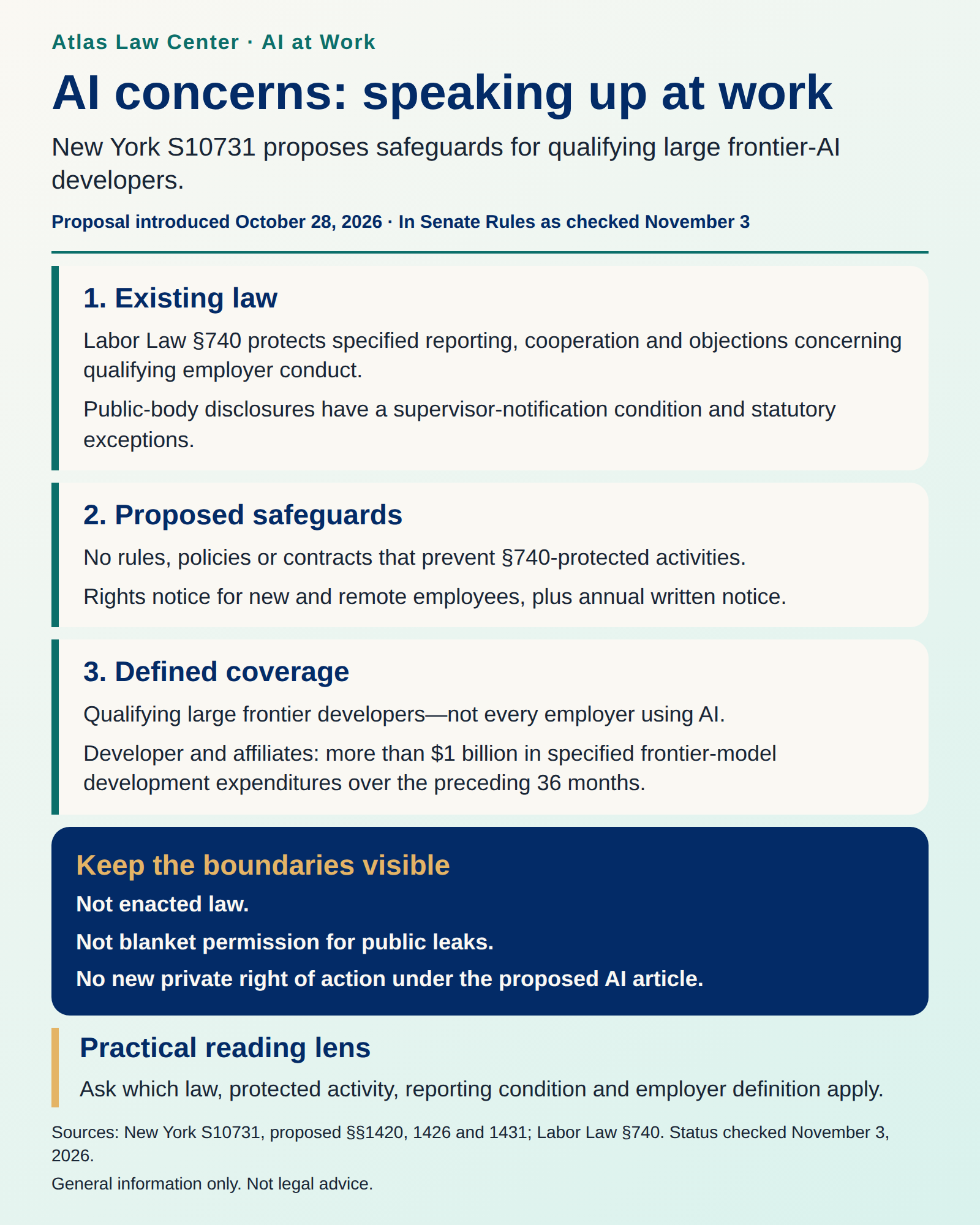
Text version of the infographic
Atlas Law Center · AI at Work
AI concerns: speaking up at work
New York S10731 proposes safeguards for qualifying large frontier-AI developers.
Proposal introduced October 28, 2026 · In Senate Rules as checked November 3
1. Existing law
Labor Law §740 protects specified reporting, cooperation and objections concerning qualifying employer conduct.
Public-body disclosures have a supervisor-notification condition and statutory exceptions.
2. Proposed safeguards
No rules, policies or contracts that prevent §740-protected activities.
Rights notice for new and remote employees, plus annual written notice.
3. Defined coverage
Qualifying large frontier developers—not every employer using AI.
Developer and affiliates: more than $1 billion in specified frontier-model development expenditures over the preceding 36 months.
Keep the boundaries visible
Not enacted law.
Not blanket permission for public leaks.
No new private right of action under the proposed AI article.
Practical reading lens
Ask which law, protected activity, reporting condition and employer definition apply.
Sources: New York S10731, proposed §§1420, 1426 and 1431; Labor Law §740. Status checked November 3, 2026.
General information only. Not legal advice.
Questions addressed
1. Has New York enacted these new AI whistleblower safeguards?
No. As checked November 3, 2026, S10731 was in the New York Senate Rules Committee. Its proposed safeguards are not enacted law. Existing New York Labor Law §740 is a separate statute; whether it protects a particular activity depends on its requirements and the facts.
2. Would the proposal cover every worker whose employer uses AI?
No. The proposed AI-specific provisions target qualifying large frontier developers, using defined developer and model terms and a specified expenditure threshold. Ordinary use of an AI tool does not by itself establish coverage. Existing whistleblower laws must be evaluated separately.
3. Would an NDA mean a worker could never report an AI-related concern?
The proposed provision would prohibit terms that prevent activities protected by Labor Law §740. That is not a declaration that every confidentiality agreement is invalid or that every public disclosure is protected. The existing statute has defined activities, reporting conditions and exceptions; a particular disclosure needs individual legal assessment.
4. Does the proposal promise a new private AI lawsuit or a reporting website available today?
No. The proposed AI article expressly does not create a private right of action, and its Attorney General website provision describes a proposed reporting mechanism. Existing Labor Law §740 separately provides a civil-action framework. This article does not determine any person’s claim or identify a newly operational reporting website.
General information only. This article does not provide legal advice or create an attorney-client relationship. It is not an assessment of a particular worker, employer, AI system, confidentiality agreement, disclosure, complaint or potential claim. Rights, coverage, obligations and remedies depend on the facts and applicable law. Laws, policies and agency guidance can change.
Wondering how this applies to you?
Every situation is different, and deadlines can be short. A free case review helps the intake team identify time-sensitive issues.
Start your free case review