
Nationwide U.S. general information and policy analysis; Maine report used as a state-specific research example, not as a statement of binding law
The headline and the desk are not the same thing
A new Maine Center for Economic Policy report makes a careful point that is useful well beyond Maine: AI exposure does not automatically mean job loss. Its October 22 report says there is limited evidence so far of widespread AI displacement, while warning that disruption can still be concentrated in particular occupations, communities, or groups of workers.
Yale Budget Lab reached a similarly narrow conclusion in its October 14 update. Its current national analysis says it does not yet find a clear AI-related labor-market footprint in occupational mix, employment, or unemployment measures. That is an observation about broad data, not a guarantee about a particular employer, role, or worker. Read Yale’s update.
A labor-market headline is like a weather map. It can show a large system moving through a region, but it cannot tell a person whether the roof over one particular house will leak. In the same way, an aggregate employment chart cannot tell a worker whether a new tool is changing their tasks, pace, schedule, supervision, or path to advancement.
AI exposure measures tasks, not a worker’s fate
“AI exposure” is often used as if it were a count of jobs that will disappear. It is not. Exposure measures usually ask whether technology could help perform parts of a job, not whether an employer will remove the job, how quickly it will do so, or what new work will be created around the tool.
The Maine report uses occupational exposure measures to examine how AI could affect work across occupations. Those measures concern potential task assistance or automation. They do not announce a termination, a pay change, or a legal conclusion about a specific workplace. Read the full report.
The International Labour Organization makes a related distinction. It separates AI used to automate tasks from AI used to automate managerial functions, sometimes called algorithmic management. It also explains that task automation does not necessarily create redundancies. The result depends on which task changes, how the employer reorganizes work, and whether people remain involved in performing or overseeing it. Read the ILO’s AI-at-work overview.
A job can change before it disappears
A job title may stay the same while the practical job changes underneath it. Four changes are worth noticing.
1. The task mix can shift
An AI tool may draft, summarize, route, translate, search, classify, schedule, or generate code. The worker may then spend more time checking output, handling exceptions, explaining mistakes, or doing the work the tool cannot do. That may make some work easier. It may also move responsibility without removing pressure.
2. The workload can shift
Faster production can create a new expectation to review more material, answer more messages, serve more customers, or correct more AI-generated work. The useful question is not simply whether the tool saves time. It is whether the saved time becomes breathing room, more work, or a new kind of accountability.
For an explanation of why human review and response time can still matter after a tool runs, read When AI Speeds Up, Your Time Still Counts. That article provides general information only; wage-and-hour questions depend on the facts and applicable law.
3. The way work is managed can shift
AI can be used to automate a task, but it can also be used to recommend schedules, assign work, rank productivity, flag conduct, or shape what a manager sees first. Those uses raise a different question: is the system assisting a person with work, or is it helping organize and judge people at work?
For a broader discussion of monitoring and workplace boundaries, read Watched at Work: What Employee Monitoring and AI Surveillance Can and Cannot Do. The fact that a tool is called AI does not itself decide whether a workplace practice is lawful or unlawful.
4. The path into and through work can shift
If AI takes over routine starter tasks, a workplace can unintentionally narrow the supervised practice that helps people learn a role. If AI produces a new stream of exceptions and review work, it can also create different skills and roles. A fair transition asks who gets training, who is trusted with higher-value work, and whether entry-level workers still have a path to build experience.
For an earlier look at that question, read AI and the First Rung of Work.
Four questions are more useful than one prediction
No worker needs to solve the entire future of AI to understand what is happening at work. A practical conversation can begin with four questions.
- What task is changing, and what new work is being added around it?
- Has the pace, workload, schedule, review responsibility, or performance expectation changed?
- Is the tool affecting how work is assigned, measured, or evaluated, and can a person explain or correct an error?
- Who is receiving training, access to new work, and a real path to advance as the job changes?
These questions do not turn a workplace change into a legal claim. They help separate a broad technology forecast from the facts that may matter at one workplace.
The Maine report is a policy proposal, not a new law
The October 22 Maine report recommends measures such as AI-related layoff disclosure, impact assessments, human review of AI employment decisions, limits on certain surveillance and wage-setting uses, employee-data protections, and consent for certain digital replacements. Those are policy proposals. They are not new statewide legal duties created by the report itself. Read the report’s recommendations.
That distinction matters. A report can identify a real workplace risk without creating a new legal rule. The legal effect of an AI-related workplace practice depends on the conduct, the worker’s role, the employer, the jurisdiction, any contract or collective-bargaining agreement, and the law that applies.
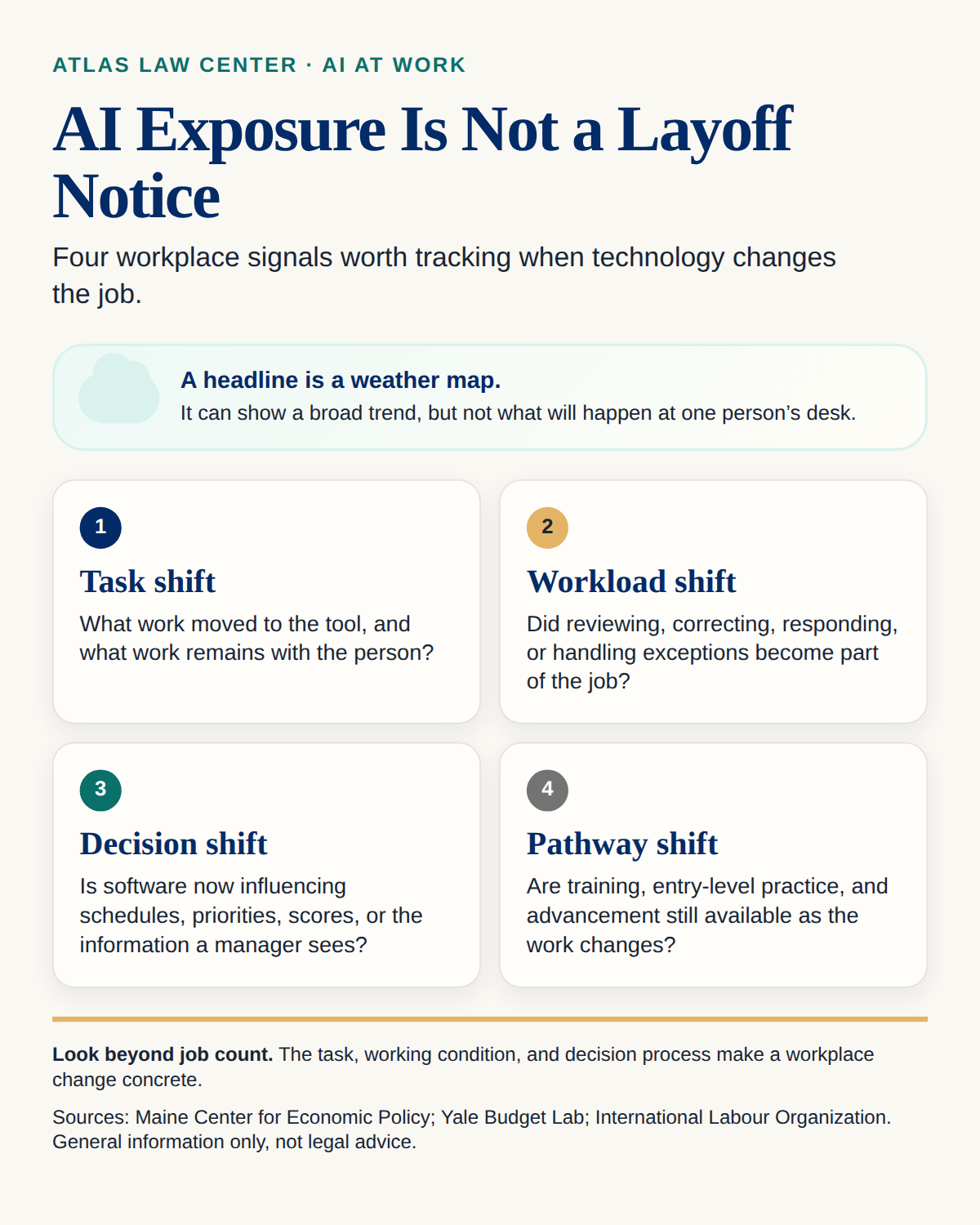
Text version of the infographic
The full text below is the selectable-text companion to the infographic. It preserves every phrase in the visual for readers using a phone, enlarged text, or a screen reader.
AI Exposure Is Not a Layoff Notice
Four workplace signals worth tracking when technology changes the job.
A headline is a weather map. It can show a broad trend, but not what will happen at one person’s desk.
- Task shift: What work moved to the tool, and what work remains with the person?
- Workload shift: Did reviewing, correcting, responding, or handling exceptions become part of the job?
- Decision shift: Is software now influencing schedules, priorities, scores, or the information a manager sees?
- Pathway shift: Are training, entry-level practice, and advancement still available as the work changes?
Look beyond job count. The task, working condition, and decision process make a workplace change concrete.
Sources: Maine Center for Economic Policy; Yale Budget Lab; International Labour Organization. General information only, not legal advice.
Questions addressed
1. Does AI exposure mean my job is about to disappear?
No. AI exposure generally measures whether technology could affect tasks within an occupation. It does not establish that an employer will eliminate a specific job, when a change might happen, or whether the tool will assist rather than replace parts of the work.
2. If there is no broad AI layoff wave, why should workers pay attention?
A workplace can change before a job disappears. AI can alter tasks, workload, review duties, data collection, scheduling, performance measurement, training, or access to advancement. Broad labor-market data cannot answer what is happening in one workplace.
3. Is the Maine report a new law that employers must follow?
No. The October 22, 2026 Maine Center for Economic Policy report is a policy report. Its recommendations describe measures policymakers could consider; the report itself does not create new legal duties for employers or new rights for workers.
4. What is the difference between AI task automation and AI management?
Task automation uses technology to perform or assist with work activities. AI management uses data or algorithms to help organize, assign, monitor, evaluate, or otherwise manage people at work. A tool can involve one or both uses, and the practical and legal questions depend on how it is used.
General information only. This article does not provide legal advice or create an attorney-client relationship. It is not an assessment of a particular worker, employer, AI system, workplace policy, data practice, employment agreement, collective-bargaining agreement, complaint, or potential claim. Rights, coverage, obligations, and remedies depend on the facts and applicable law.
Wondering how this applies to you?
Every situation is different, and deadlines can be short. A free case review helps the intake team identify time-sensitive issues.
Start your free case review