
China national policy analysis; not a statement of United States law or an individual worker-rights determination
China is putting employment risk inside the AI policy conversation
A report on the Chinese government’s English-language website, updated October 23, 2026 and credited to Xinhua, describes guidelines issued by the General Office of the State Council. They set out 18 tasks in six areas: job creation, employment-friendly AI adoption, digital skills, employment services, labor and social-security protections, and employment-risk monitoring and response. Read the government-hosted English report.
The important idea is upstream. Instead of treating employment effects as something to discuss only after a workplace has changed, the policy calls for an employment-risk assessment mechanism for AI adoption. The official Chinese text says that AI application projects in market-access fields that may have a relatively large employment impact should undergo employment-risk assessment during project review. It also says other AI application projects should be assessed in light of actual circumstances. Read the official Chinese policy text.
This is a policy framework, not a personal legal claim. It is closer to putting a people-impact review into a building plan than to handing a worker a finished remedy. A plan can require officials to consider the load before construction. It does not itself tell one tenant what will happen in a particular room.
What the policy asks public systems and employers to consider
The policy has a broad employment focus. Four parts are especially relevant to the workplace effects of AI.
1. Pace and place of deployment
The Chinese policy says AI should be promoted first in labor-short and high-risk work environments. It also calls for care about the scope, intensity, and pace of AI use in labor-intensive industries in order to reduce the impact on workers. Those directions do not mean every deployment must stop. They show that the policy treats the setting of a rollout as part of the employment question. Read the source text.
2. Employment-risk assessment and transition support
The policy directs assessment of employment effects for certain potentially high-impact AI projects and says relevant departments should coordinate support for job transitions. It also calls for employment guidance, skills training, job referrals, and entrepreneurship support for eligible workers affected by AI-related job replacement. Read the official Chinese policy text.
That does not establish that a worker has already been displaced, or that any particular worker qualifies for a service. It identifies transition support as a policy response when AI affects employment.
3. Human-machine collaboration and worker protections
The policy calls for research on basic worker protections in human-machine collaboration and for a consultation-and-coordination mechanism concerning workers’ rights. It says enterprises should protect lawful rights involving remuneration, rest and leave, and occupational safety and health. It also calls for governance of AI in human-resources management and for action against unlawful or improper practices involving algorithm abuse, employment discrimination, false recruitment, privacy, and rest rights. Read the official Chinese policy text.
These statements point to the kinds of work conditions policymakers are watching. They do not decide whether an individual worker has a claim, whether an employer’s practice is lawful, or what remedy applies in any other jurisdiction.
4. Monitoring before a broad employment shock becomes visible
The policy also calls for data sharing, regional and industry employment monitoring, early warning, research on AI’s effects on employment and income distribution, and response plans for AI-related employment risks. Read the official Chinese policy text.
That matters because a job can change before a job count changes. For a broader U.S. general-information discussion of that point, read AI Is Not a Layoff Notice—But It Can Change Work. The Atlas article is not evidence that the Chinese policy creates any U.S. obligation; it explains why tasks, workload, data, training, and supervision can matter before a job disappears.
What this policy does not establish
The document is an opinion issued by China’s State Council General Office and dated October 16, 2026. It directs and encourages a package of policy work. It does not identify a general individual complaint path, a universal AI-project threshold, a U.S. legal duty, or a uniform advance-notice rule for every employer using AI. Read the official text.
The source says enterprises are encouraged to explore an unemployment-buffer period, early notice to affected workers, and transition support when deploying AI at scale. Encouragement to explore a practice is different from a universally stated duty. The policy must be read with the implementation steps, institutions, and laws that apply in China; it does not answer what an employer or worker in the United States must do.
For another international discussion of how AI systems can rely on work that remains human, read The Human Work Behind Every AI System. That article explains a different question: the people who label, test, review, and maintain AI systems. It does not interpret China’s policy.
A useful question before calling a rollout “efficient”
A policy document cannot tell a worker whether a particular change will help or hurt. It can still identify a better starting question: before a system is scaled, what does it change about jobs, working conditions, transition support, and the ability to raise concerns?
That question is useful beyond China, but the legal answers remain local. Employment status, contracts, collective agreements, privacy rules, safety rules, discrimination law, wage-and-hour law, and public programs vary. A policy framework is a map for what to examine. It is not a substitute for the rules that govern a particular workplace.
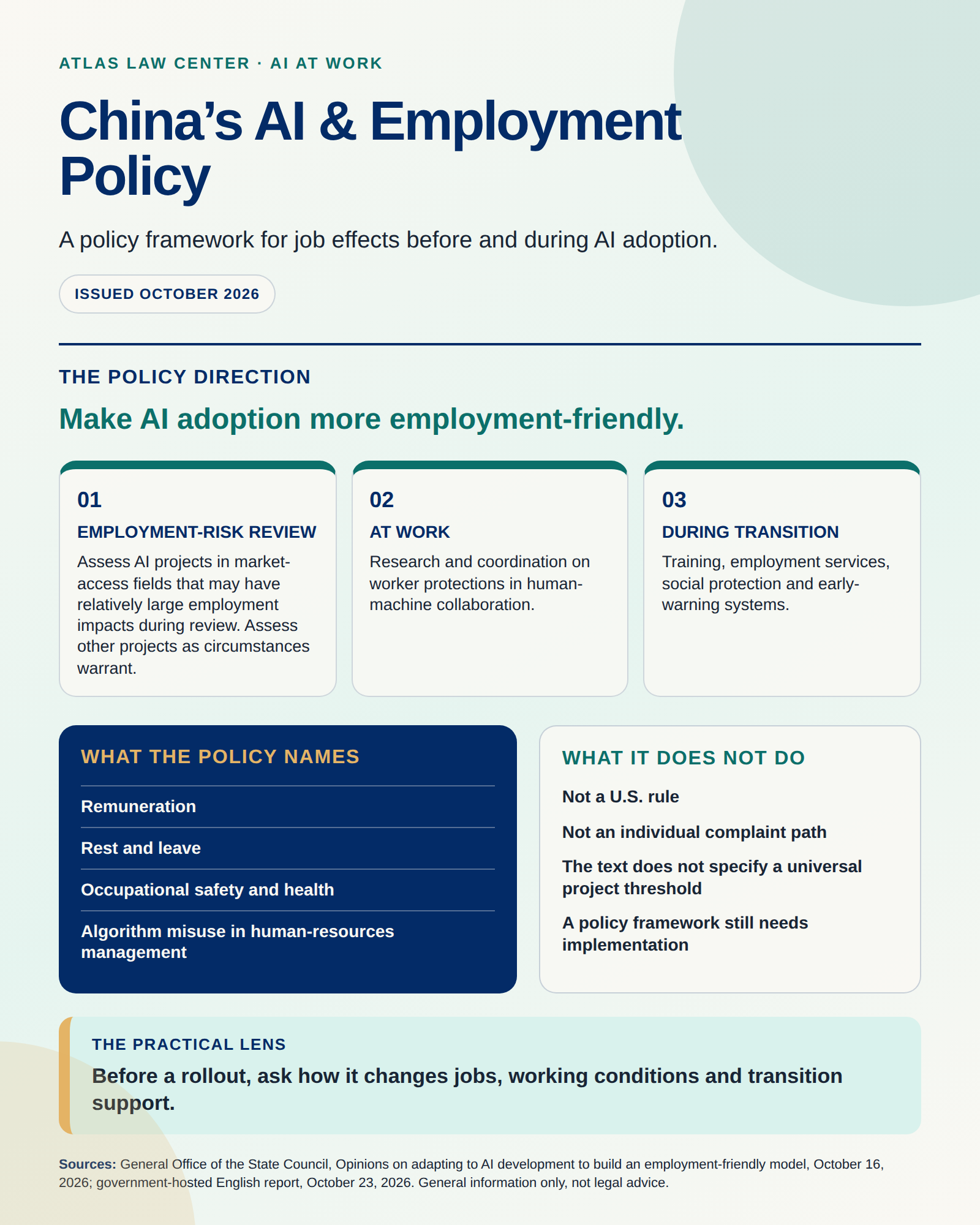
Text version of the infographic
ATLAS LAW CENTER · AI AT WORK
China’s AI & Employment Policy
A policy framework for job effects before and during AI adoption.
ISSUED OCTOBER 2026
THE POLICY DIRECTION
Make AI adoption more employment-friendly.
01
EMPLOYMENT-RISK REVIEW
Assess AI projects in market-access fields that may have relatively large employment impacts during review. Assess other projects as circumstances warrant.
02
AT WORK
Research and coordination on worker protections in human-machine collaboration.
03
DURING TRANSITION
Training, employment services, social protection and early-warning systems.
WHAT THE POLICY NAMES
Remuneration
Rest and leave
Occupational safety and health
Algorithm misuse in human-resources management
WHAT IT DOES NOT DO
Not a U.S. rule
Not an individual complaint path
The text does not specify a universal project threshold
A policy framework still needs implementation
THE PRACTICAL LENS
Before a rollout, ask how it changes jobs, working conditions and transition support.
Sources: General Office of the State Council, Opinions on adapting to AI development to build an employment-friendly model, October 16, 2026; government-hosted English report, October 23, 2026. General information only, not legal advice.
Questions addressed
1. What does China’s AI employment policy call for?
It calls for an employment-friendly approach to AI that includes job-creation measures, employment-risk assessment, skills and transition support, worker-protection research, social-security measures, and monitoring and response systems. The official Chinese text says certain AI projects in market-access fields that may have a relatively large employment impact should receive employment-risk assessment during project review.
2. Does this policy give an individual worker a new complaint or remedy?
The source is a policy framework issued by China’s State Council General Office. It does not identify a general individual complaint process or decide a particular worker’s entitlement, workplace dispute, or remedy. Applicable rights and procedures depend on the relevant law, institution, and facts.
3. Does the policy require every employer to give advance notice before using AI?
No universal advance-notice duty is stated in the text. The policy encourages enterprises to explore an unemployment-buffer period, early notice to affected workers, and transition support when AI is deployed at scale. Encouragement to explore a practice is not the same as a universally stated legal requirement.
4. Does China’s policy change U.S. workplace law?
No. The policy concerns China’s employment-policy approach to AI. It does not create a U.S. employment-law right, duty, complaint route, or answer for a particular workplace. U.S. rights and obligations depend on applicable federal, state, and local law and the facts.
This page provides general information, not legal advice, and does not create an attorney-client relationship. It is not an assessment of a particular worker, employer, AI system, workplace policy, employment agreement, collective-bargaining agreement, benefit, safety issue, privacy practice, complaint, or potential claim. This is a China policy analysis, not a statement of United States law. Rights, coverage, obligations, and remedies depend on the facts and applicable law. Laws, policies, and agency guidance can change.
Wondering how this applies to you?
Every situation is different, and deadlines can be short. A free case review helps the intake team identify time-sensitive issues.
Start your free case review