
Global policy analysis with a limited federal FLSA classification context. State, local, foreign, contract, and collective-bargaining rules can differ.
AI has a human supply chain
A person can experience AI as a chatbot, a recommendation, a summary, or an automated score. That surface can hide the labor that helps make the system work. The International Labour Organization explains that AI development and deployment can require people to tag, classify, clean, and validate data, as well as workers who help assess and refine outputs. Some of that work is organized through online microtask platforms or AI business-process outsourcing companies. Read the ILO’s AI overview.
A useful analogy is a restaurant dining room. The customer sees the finished plate, not the preparation, stocking, dishwashing, and coordination behind the kitchen door. AI is not literally a restaurant, and not every system relies on the same kind of labor. But the analogy helps explain why a polished output should not erase the people whose work helped prepare, test, or maintain it.
The ILO has described data labeling, categorization, annotation, content review, and human quality checks as part of the work that can sit behind AI systems. Some of that work may be remote and flexible. Some workers may value that access to income. The conditions can also include fragmented tasks, uncertain task availability, rejected work, intensive monitoring, exposure to disturbing material, low earnings, or limited channels for questions. These are documented risks and examples, not a claim that every AI-related job or platform works the same way. Read the ILO’s explanation of the hidden labor behind AI.
A task can still be work even when it arrives through an app
A digital platform can route small tasks to a person: identify an object in an image, compare two responses, verify a transcript, flag harmful content, or test whether a system followed an instruction. The size of a task does not answer the larger question of how the work relationship is organized.
The Decent Work in the Platform Economy Convention, 2026 (No. 193) uses a broad international definition of digital platform work that can include work performed online or at a physical location. It does not require every platform worker to be classified as an employee. Instead, it calls for status to be determined by the facts about how work and payment operate. That is a global framework, not a determination of any worker’s U.S. legal status.
For a limited U.S. federal baseline, the Department of Labor says the Fair Labor Standards Act asks about the economic realities of the entire relationship. A job title, a 1099, or an independent-contractor agreement does not itself settle the question. The Department describes factors such as control, opportunity for profit or loss, investment, permanence, whether the work is integral to the business, and skill plus initiative. This fact sheet reflects the 2024 rule, which DOL says remains in effect for private litigation. The Wage and Hour Division uses different current enforcement guidance in its investigations. Read DOL Fact Sheet 13.
That does not mean every platform worker is an employee. It means the label alone is not the end of the analysis. The Department is also considering a proposed 2026 change to its regulations, which is not a final rule. Read the DOL rulemaking page. Classification, coverage, and remedies can depend on facts and on other applicable law.
Four conditions matter behind the prompt
The job behind an AI system is not just about whether a person receives a task. It is also about what happens before, during, and after that task. The newest international platform-work framework offers a useful lens, even though it is not a shortcut to a U.S. legal claim.
- Who sets the rate and explains deductions? A task may show a price, a completion threshold, or a deduction without explaining how the figure was reached. Convention No. 193 includes payment-information principles for platform work. A worker’s actual rights to information, minimum pay, or expenses depend on their status and applicable law.
- What happens when a system rejects work? A platform may use an automated tool to rank work, reject a task, limit access to new tasks, or deactivate an account. Convention No. 193 addresses notice about automated systems and review of certain significant decisions. It had not entered into force when this article was reviewed. Article 27 sets ratification and timing conditions for entry into force, while Article 24 addresses national implementation. It does not itself give every U.S. worker a nationwide right to a particular explanation or appeal.
- What data is collected about the worker? The system may record task results, speed, location, device information, or other data. The ILO’s platform framework includes data and privacy safeguards as a global policy model. Local privacy and employment rules can differ substantially. For a related explanation of monitoring in an ordinary workplace, read Watched at Work: What Employee Monitoring and AI Surveillance Can and Cannot Do.
- Is a person doing the hardest work without a meaningful way to raise a concern? Content moderation, error review, and repeated microtasks can create different kinds of pressure. The ILO’s research notes that AI can reshape work organization, autonomy, and job quality even when broad job displacement remains limited. Read the ILO’s evidence review.
A new international convention is a policy map, not automatic U.S. law
The ILO adopted Convention No. 193 in June 2026 as its first international labor standard focused specifically on the platform economy. Its official explanation covers online and location-based platform work, payment information, personal data, status determination, and some consequences of automated decisions. Read the ILO’s Convention No. 193 explainer.
The important limit is equally clear. Convention No. 193 had not entered into force when this article was reviewed. Article 27 provides for entry into force 12 months after two ratifications are registered and, for a later ratifying country, 12 months after its ratification is registered. Countries bound by the Convention must implement it through national measures; it does not create automatic U.S. rights. Read the official Convention text and check the official ratification status. It is a policy map, not a switch that turns on the same rules everywhere. It can help readers recognize the questions that matter without answering what a particular employer, platform, state, or court must do.
The ILO’s October 23 working paper makes a related point. It finds common ground around fairness, well-being, and harm prevention. It also identifies differences concerning privacy, autonomy, and worker and employer representation, and highlights emerging issues such as data governance, explicability, and algorithmic management. The paper is exploratory and expressly says the authors’ views do not necessarily represent the ILO. It does not create a new legal rule. Read ILO Working Paper 182.
Why visibility matters before a problem becomes an AI headline
Public conversation often jumps from “AI will replace work” to “AI will create work.” Both phrases can miss the people already doing the small, paid, and sometimes difficult jobs that keep systems operating.
The ILO’s June evidence review reports that large-scale AI-related job displacement remains limited in the research it reviewed. It also identifies active concerns around work organization, worker autonomy, job quality, inequality, and opportunities for younger workers. That is why the useful question is not only whether a model can perform a task. It is also how the remaining human work is assigned, measured, paid, and governed. Read the ILO evidence review.
For a related discussion of how software can shape ordinary assignments, measurement, and supervision, read Algorithmic Management: Who Controls Your Workday?. For the broader question of who shares AI productivity gains, read AI and the Future of Work: The New Time Divide.
A practical starting point for workers
A person doing AI-related platform or data work can begin with basic, factual questions. What entity is offering the work? What document explains the rate, task rules, deductions, and payment timing? What data does the platform collect? What happens if a task is rejected or an account is limited? Is there a clear contact path for a payment or safety question?
Those questions do not decide legal status or create a legal claim. They help reveal the actual relationship behind a simple-looking task. If a worker believes an employer or platform has denied pay, imposed an employment decision, or used personal data in a way that may violate applicable law, they should preserve lawful records privately and seek qualified advice about their specific facts. Do not post work documents or personal information in a public comment or AI tool.
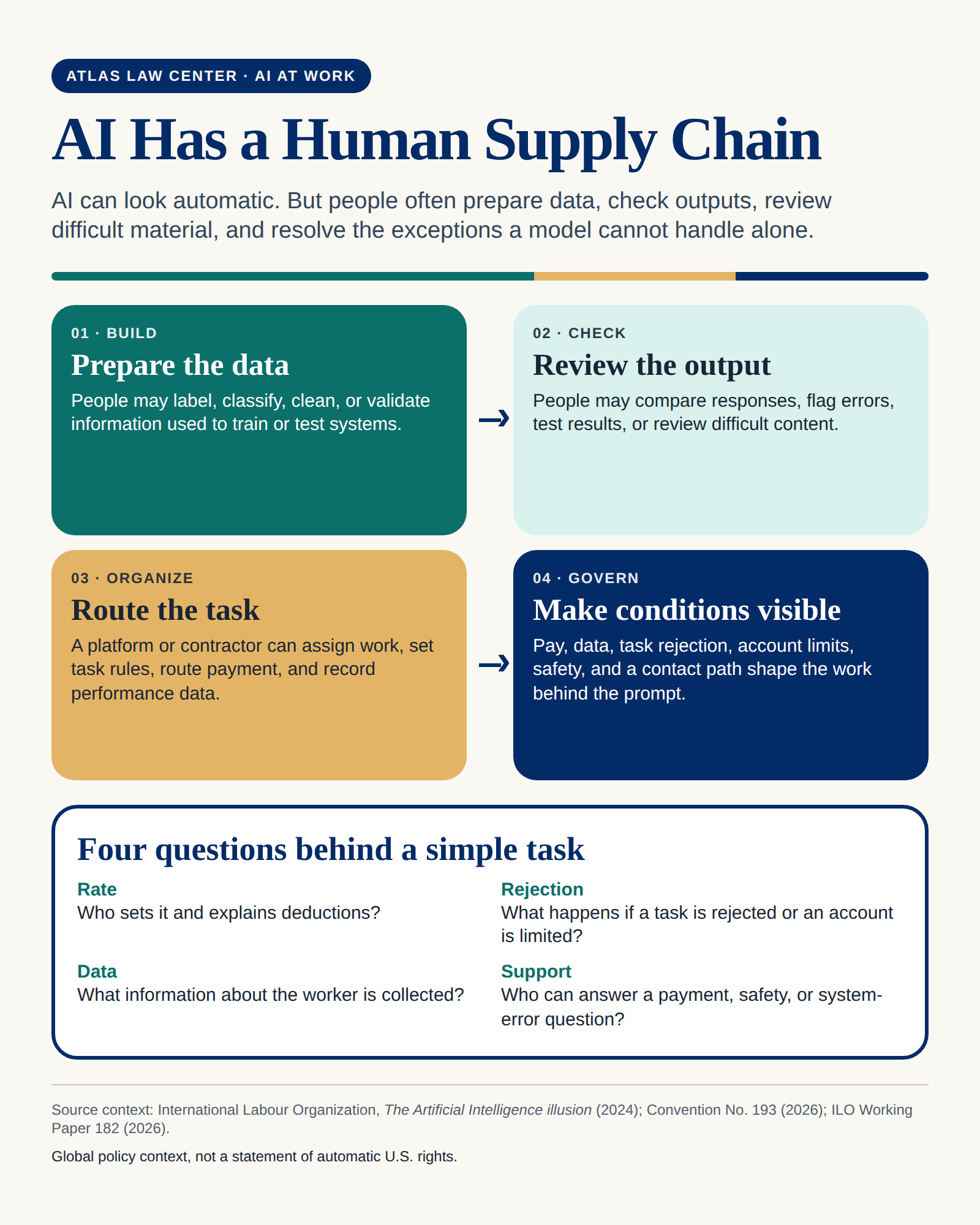
Text version of the infographic
ATLAS LAW CENTER · AI AT WORK
AI Has a Human Supply Chain
AI can look automatic. But people often prepare data, check outputs, review difficult material, and resolve the exceptions a model cannot handle alone.
01 · BUILD
Prepare the data
People may label, classify, clean, or validate information used to train or test systems.
02 · CHECK
Review the output
People may compare responses, flag errors, test results, or review difficult content.
03 · ORGANIZE
Route the task
A platform or contractor can assign work, set task rules, route payment, and record performance data.
04 · GOVERN
Make conditions visible
Pay, data, task rejection, account limits, safety, and a contact path shape the work behind the prompt.
Four questions behind a simple task
Rate
Who sets it and explains deductions?
Rejection
What happens if a task is rejected or an account is limited?
Data
What information about the worker is collected?
Support
Who can answer a payment, safety, or system-error question?
Source context: International Labour Organization, The Artificial Intelligence illusion (2024); Convention No. 193 (2026); ILO Working Paper 182 (2026).
Global policy context, not a statement of automatic U.S. rights.
Questions addressed
1. What is the human work behind AI?
People may label, categorize, clean, and validate data; test outputs; verify responses; or review difficult content. AI systems vary, and not every system uses the same amount or kind of human work. The ILO describes this work as an important part of the AI value chain.
2. Does a platform calling me a contractor decide my legal status?
No. Under DOL’s Fact Sheet 13, a title, 1099, or agreement alone does not decide employee or independent-contractor status. That fact sheet reflects the 2024 rule, which DOL says remains in effect for private litigation, while the Department uses different guidance in its investigations. The economic realities of the whole relationship matter. The answer can depend on the facts, the law involved, and state or local rules.
3. Does ILO Convention No. 193 give every U.S. platform worker new rights?
No. Convention No. 193 is an international framework adopted in 2026, but it had not entered into force when this article was reviewed. Article 27 provides for entry into force 12 months after two ratifications are registered and, for a later ratifying country, 12 months after its ratification is registered. Article 24 addresses implementation through national measures. It is useful context for questions about platform work, automated decisions, payment information, and worker data. It does not create automatic U.S. rights.
Read the official Convention text and check the official ratification status.
4. Why do automated task rejections or account limits matter?
They can affect whether a person is paid, receives more work, or can keep using a platform. The ILO’s new framework treats some automated work decisions as an area where notice, explanation, review, and human involvement can matter. The legal effect for a particular worker depends on the applicable jurisdiction and facts.
This is global policy context with a limited U.S. federal classification baseline. It is not legal advice, does not decide any worker’s legal status, and does not create an attorney-client relationship. The ILO Convention and working paper discussed below are not U.S. law.
Wondering how this applies to you?
Every situation is different, and deadlines can be short. A free case review helps the intake team identify time-sensitive issues.
Start your free case review