
Italy, with limited international occupational-safety context. Local, contract, collective-bargaining, and sector-specific rules can differ.
A new rule asks what the technology changes around the job
Italy’s Legislative Decree No. 179 of 2026 took effect on October 23. Its Article 42 is titled “Artificial intelligence, health and safety in workplaces.” It says that the use of AI systems affecting work organization, production rhythms, how work is performed, or decision-making processes relevant to safety must be evaluated within the workplace risk assessment required by Italy’s workplace-safety framework. Read the official Article 42 text.
That wording matters because it directs attention to the job, not only to the tool. A system might be marketed as a scheduling aid, a productivity assistant, a quality-control program, or a safety tool. Article 42 asks a different practical question: what does the system change about how people work?
A useful analogy is new equipment on a production floor. The question is not only whether the equipment turns on. It is also whether it changes the pace, task design, supervision, or safe way of doing the work. Italy’s rule applies that kind of workplace-risk lens to certain uses of AI.
What Article 42 says
Article 42 has four connected paragraphs.
- Coordinate health-and-safety measures. Paragraph 1 says the Ministry of Labour and Social Policies coordinates measures so that AI is introduced and used at work in a way that respects principles protecting workers’ health and safety. It acts within the responsibilities assigned by Italy’s existing workplace-safety decree. Read the official Article 42 text.
- Assess specified AI effects as part of workplace risk assessment. Paragraph 2 covers AI use affecting work organization, production rhythms, how work is performed, or safety-relevant decision processes. That use is assessed within Article 28 of Legislative Decree No. 81 of 2008. Read the official Article 42 text.
- Give workers adequate information and training. Paragraph 3 separately says employers ensure adequate information and training about the specific risks connected with using AI systems and the prevention and protection measures adopted. Read the official Article 42 text.
- Promote responsible use for prevention. Paragraph 4 says the Ministry promotes responsible AI use as a tool for preventing occupational accidents and diseases. It coordinates with the National Labour Inspectorate and other competent institutions. This does not mean every AI tool is safe or unsafe by definition. Read the official Article 42 text.
Why work pace belongs in a safety conversation
People often picture workplace safety as guards on machinery, protective equipment, or a physical hazard. Those issues remain important. But software can also reshape the conditions under which people work: how quickly tasks arrive, how many tasks fit into a shift, how much discretion a worker has, and whether a system’s recommendation is treated as the final word.
ILO Working Paper 170 describes how AI can affect psychosocial work conditions such as workload and work pace, job control, intrusive monitoring, lack of workplace transparency, and work intensification. It is research and policy analysis, not a binding rule. Still, it explains why a workplace may need to look beyond a system’s accuracy rate and consider what the technology changes about the human work around it. Read the ILO’s AI and psychosocial-work analysis.
Article 42 supplies a concrete legal example of that broader idea. It does not say that every AI deployment is harmful. It says that specified effects on work organization, pace, performance, or safety-related decisions belong in a workplace-risk assessment.
What this rule does not say
Italy’s provision is specific, and its limits matter.
- It does not ban all workplace AI. Article 42 is not a general prohibition on AI. It directs certain AI effects into a workplace-risk assessment and requires worker information and training about AI-specific risks.
- It does not make every work decision a safety decision. The text includes decision-making processes relevant to safety. Whether a particular use falls inside the provision requires a fact-specific assessment under Italian law.
- It does not create a universal U.S. rule. The provision is Italian law. A worker or employer in the United States must look to the law, contract, collective-bargaining agreement, workplace setting, and facts that actually apply. The Italian example can clarify a policy question, but it does not answer a U.S. legal claim.
Four factual questions that make an AI rollout easier to see
A worker, manager, safety representative, or union representative can begin with concrete questions rather than a broad debate about whether AI is good or bad.
- Does the system affect the organization of work? For example, does it change who receives a task, when a task arrives, or how a team is coordinated?
- Does it affect pace? A system that raises production targets, increases task flow, or shortens the time allowed for a task can change the conditions of work even when it does not make a final employment decision.
- Does it change how the task is performed? A recommendation, checklist, route, alert, or quality score can alter the way a person performs a job.
- Does it matter to safety? If a tool influences a safety-related decision, the question is not merely whether the tool is useful. It is also what risks and protections are relevant in that workplace.
Those questions do not determine whether Article 42 applies, whether an employer has violated any rule, or whether another country’s law provides a remedy. They make the operational effect of the technology visible. That is the starting point of the Italian provision.
A useful comparison for U.S. readers
Italy’s rule does not change U.S. law. But it shows one way a legal system can frame workplace AI: not only as a hiring, privacy, or bias question, but also as a question about job design and safety.
For separate U.S.-focused explainers about work assignment, monitoring, and AI-driven workplace change, read Algorithmic Management: Who Controls Your Workday?, Watched at Work: What Employee Monitoring and AI Surveillance Can and Cannot Do, and AI Is Not a Layoff Notice: What Workplace Change Can Actually Mean. Each addresses a different question and does not replace fact-specific advice about a particular workplace.
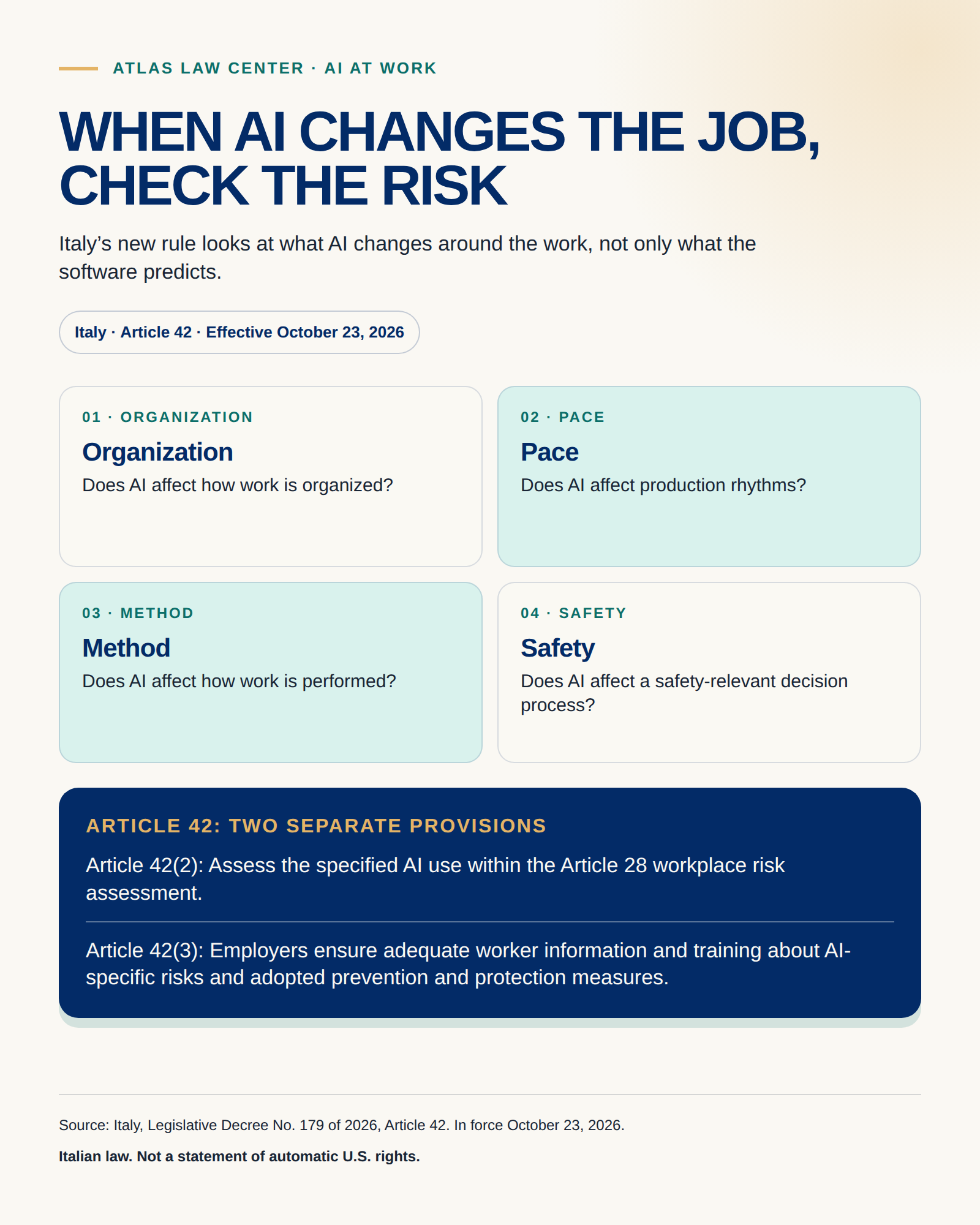
Text version of the infographic
ATLAS LAW CENTER · AI AT WORK
WHEN AI CHANGES THE JOB, CHECK THE RISK
Italy’s new rule looks at what AI changes around the work, not only what the software predicts.
Italy · Article 42 · Effective October 23, 2026
01 · ORGANIZATION
Organization
Does AI affect how work is organized?
02 · PACE
Pace
Does AI affect production rhythms?
03 · METHOD
Method
Does AI affect how work is performed?
04 · SAFETY
Safety
Does AI affect a safety-relevant decision process?
ARTICLE 42: TWO SEPARATE PROVISIONS
Article 42(2): Assess the specified AI use within the Article 28 workplace risk assessment.
Article 42(3): Employers ensure adequate worker information and training about AI-specific risks and adopted prevention and protection measures.
Source: Italy, Legislative Decree No. 179 of 2026, Article 42. In force October 23, 2026.
Italian law. Not a statement of automatic U.S. rights.
Questions addressed
1. Does Italy’s Article 42 ban workplace AI?
No. Article 42 does not ban all workplace AI. It requires certain AI uses that affect work organization, production rhythms, how work is performed, or safety-relevant decision-making to be evaluated within the workplace risk-assessment framework. It also requires adequate worker information and training about AI-specific risks and adopted prevention and protection measures.
2. Why does Article 42 mention production pace?
The provision explicitly includes AI that affects production rhythms. The point is that technology can change work conditions through the pace, organization, or method of work, even when it is not making a final hiring or firing decision. Whether a particular system is covered depends on the facts and the Italian legal framework.
3. Does this Italian rule change a U.S. worker’s rights?
No. Article 42 is Italian law. It does not itself create a U.S. right or decide whether a rule applies in a U.S. workplace. The applicable law can depend on the jurisdiction, the work setting, a contract or collective-bargaining agreement, and the specific facts.
4. What information and training does Article 42 require?
Article 42 says employers must ensure adequate worker information and training about the specific risks connected to the use of AI systems and about the prevention and protection measures adopted. The provision does not turn a generic software demonstration into a substitute for risk-specific information and training.
This article describes an Italian legal development and limited international workplace-safety context. It is not legal advice, does not decide whether any rule applies to a particular workplace, and does not create an attorney-client relationship. Italy’s law does not itself change U.S. workplace law.
Wondering how this applies to you?
Every situation is different, and deadlines can be short. A free case review helps the intake team identify time-sensitive issues.
Start your free case review