
Japan public-sector AI workflow, used as an international workplace example. Not a statement of U.S. legal requirements or a finding about any employee’s personal liability.
A government draft still needs a government judgment
Japan’s Digital Agency launched a prototype of “Diet Answer Support AI” on October 30. The Diet is Japan’s national parliament. The application helps officials prepare answers to parliamentary questions through information retrieval, organization, draft generation and support for checking content. Read the official launch announcement. Confirm the date on the agency’s GENAI index.
The task is demanding because officials must find relevant past answers and supporting material, understand the question and prepare a consistent response under tight deadlines. That is the agency’s description of the work—not a finding that an AI tool has solved it. The announcement says the prototype is meant to help with the preparation while keeping human review and final decision-making in place. Read the agency’s description of the workflow.
An AI draft is like a newly drawn map. Clear lines can make it look useful, but someone must still check that the roads exist and that the route reaches the right destination. Here, the supporting documents are the ground beneath the map. The analogy does not make the AI a reliable navigator; it explains why polished wording is not evidence that an answer is correct.
Three checks stand between a draft and an answer
The agency warns that generative AI can produce plausible but incorrect or unsupported content—often called a hallucination. It says accuracy and validity cannot be guaranteed. As a general rule, its AI information and drafts will not be adopted exactly as supplied. Officials must cross-check them against supporting documents. The release identifies three things to verify. Read the stated verification requirements.
1. Factual accuracy
The question is whether the supporting document actually establishes the statement in the draft. An illustrative example: if a source calls a program a trial, a draft should not describe it as a completed nationwide rollout. Fluent wording cannot repair that change in meaning. This example illustrates the check; it is not a report of an error by the Japanese prototype.
2. Consistency with past answers and government policies
An answer may contain a correct isolated fact but still contradict an earlier official answer or misstate the government’s current policy. The agency’s workflow requires comparison with both. The check is broader than asking whether the paragraph sounds reasonable. It asks whether the answer fits the institution’s actual record and position. Read the consistency requirement.
3. Appropriate phrasing
The agency also requires officials to check wording. A sentence can overstate certainty, answer a different question or blur a planned action with a completed one. Those are illustrative ways phrasing can matter, not measured failures of this tool. In this workflow, the human reviewer is not merely adding a signature to an untouched AI answer. Read the phrasing requirement.
Human responsibility is an institutional process
The announcement keeps policy judgments, the formulation of official views and the finalization of answers with government officials. It says decision-making will not be delegated to AI. Ministers and other respondents will deliver answers based on drafts thoroughly reviewed and coordinated by the responsible officials and relevant divisions. Read the division of responsibility.
That is not a statement that one employee personally carries every legal risk. It describes a reviewed and coordinated government process. The distinction matters at any workplace trying to understand a new drafting tool: “a person is involved” is less informative than knowing what that person checks and who can approve the result.
For a separate discussion of how review work can affect human hours, read When AI Speeds Up, Your Time Still Counts. Today’s article concerns the evidentiary path to an official answer, not whether a particular review task is compensable work.
A large access figure is not a success measurement
The agency says the tool will be available to approximately 180,000 government employees. That is an availability figure. It does not mean 180,000 people are using it, and it is not evidence of how much time the prototype saves. Read the access statement.
During development, 102 experienced officials from 16 ministries and agencies served as evaluators selected through an open call. They commented on screen layout, usability and required functions. The agency says some suggestions have been incorporated. These figures describe development feedback, not a representative worker poll or a controlled study establishing better outcomes. They also do not prove that every affected worker consented to the tool. Read the evaluation description.
The prototype is being provided on a trial basis during the 222nd Extraordinary Session of the Diet to assess effectiveness, usability and output quality. A full-scale rollout during the Ordinary Session starting in January 2027 is planned. It has not happened merely because the plan is announced. The launch release gives no quantified reduction in workload or error rate for this prototype. Read the trial and planned rollout.
The useful lesson is a visible path to approval
The concrete workplace question is not just whether software can generate an answer. It is whether the workflow makes the source check, consistency check, wording review and final approval visible. Japan’s announcement provides a specific example of those stages. It does not prove every organization using them will get reliable results.
This example also does not authorize workers to put confidential records into any AI product. The article describes a named government environment; it supplies no permission for another employer’s documents or a consumer chatbot. Nor does it create a U.S. legal duty, a defense to discipline or a personal-liability rule.
For broader context on how technology changes a job without necessarily removing it, read AI Is Not a Layoff Notice—But It Can Change Work. The narrower point here is that generating a document and making it ready to represent an institution are different steps.
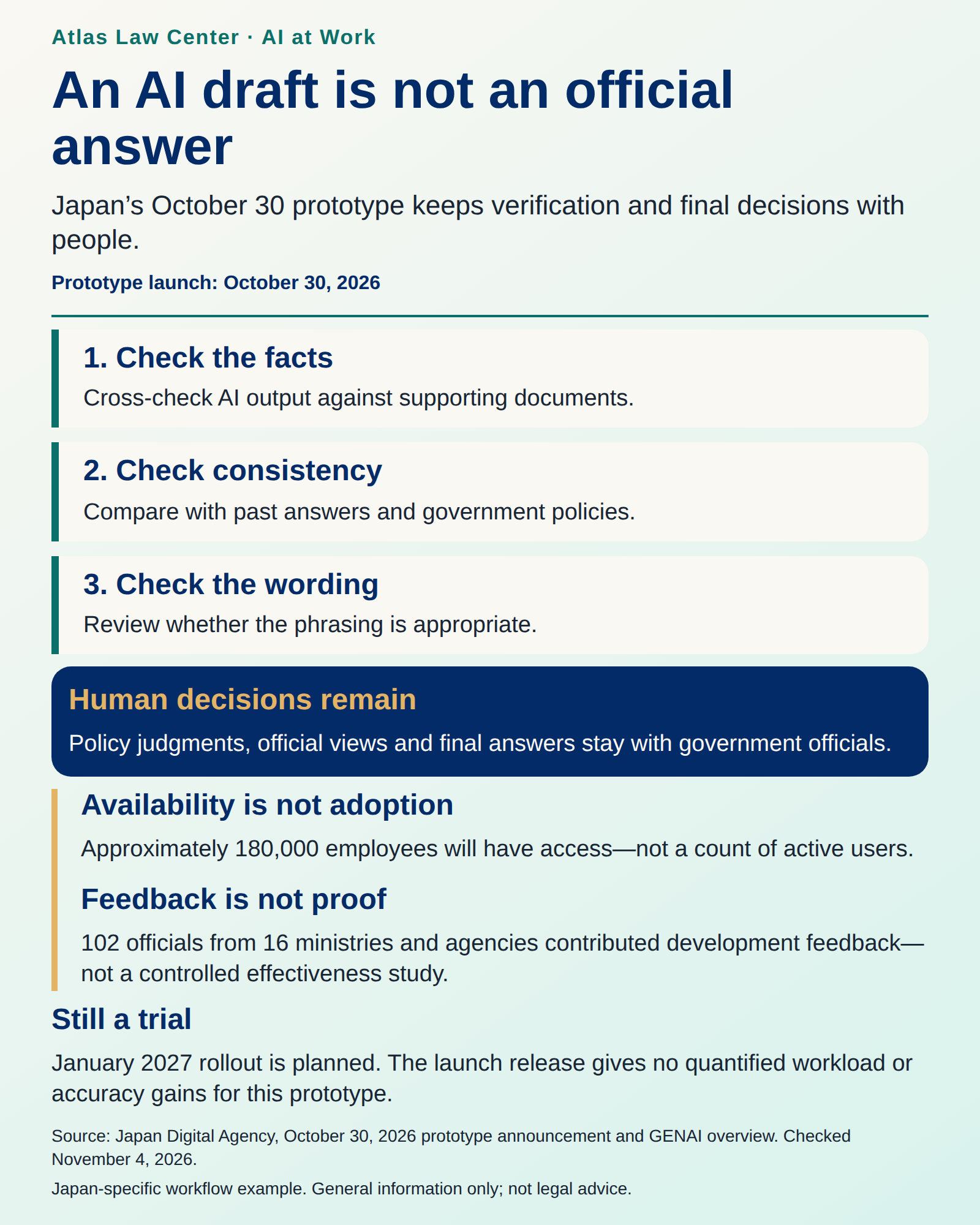
Text version of the infographic
The following selectable text preserves every visible infographic string in display order. Keep it in the initial public HTML beside the image so phone, enlarged-text and screen-reader users receive the same meaning.
Atlas Law Center · AI at Work
An AI draft is not an official answer
Japan’s October 30 prototype keeps verification and final decisions with people.
Prototype launch: October 30, 2026
1. Check the facts
Cross-check AI output against supporting documents.
2. Check consistency
Compare with past answers and government policies.
3. Check the wording
Review whether the phrasing is appropriate.
Human decisions remain
Policy judgments, official views and final answers stay with government officials.
Availability is not adoption
Approximately 180,000 employees will have access—not a count of active users.
Feedback is not proof
102 officials from 16 ministries and agencies contributed development feedback—not a controlled effectiveness study.
Still a trial
January 2027 rollout is planned. The launch release gives no quantified workload or accuracy gains for this prototype.
Source: Japan Digital Agency, October 30, 2026 prototype announcement and GENAI overview. Checked November 4, 2026.
Japan-specific workflow example. General information only; not legal advice.
Questions addressed
1. Does Japan’s new prototype make final government decisions?
No. The Digital Agency says the tool assists drafting and verification. Policy judgments, official government views and final answers remain with government officials. The announcement says AI output is generally not adopted exactly as provided and must be checked against supporting documents.
2. Does access for about 180,000 employees mean all of them use the tool?
No. The announcement describes approximately 180,000 government employees having access to the prototype. It does not report that all of them are active users or provide a measured adoption rate.
3. Has this prototype been shown to reduce workload or improve accuracy?
The October 30 launch release describes the intended benefits and a trial to assess effectiveness, usability and output quality. It gives no quantified workload reduction or accuracy improvement for this prototype. Feedback from 102 officials is development input, not a controlled effectiveness study.
4. Does this announcement create a U.S. workplace rule?
No. It describes a Japanese government workflow, not a new U.S. employment-law duty or worker right. The three verification checks are a source-based illustration of that workflow. This article does not determine anyone’s pay, liability, disciplinary exposure or permission to share restricted information.
General information disclaimer
General information only. This article does not provide legal advice or create an attorney-client relationship. It is not an assessment of a particular worker, employer, AI system, government policy, document, data practice, employment agreement, complaint or potential claim. Rights, coverage, obligations and remedies depend on the facts and applicable law. Laws, policies and agency guidance can change.
Wondering how this applies to you?
Every situation is different, and deadlines can be short. A free case review helps the intake team identify time-sensitive issues.
Start your free case review