
California-specific general legal information
A new disclosure rule, not a notice for every AI use
On September 30, 2026, Governor Gavin Newsom signed Senate Bill 951. It became Chapter 860 of the Statutes of 2026 and amended California’s Worker Adjustment and Retraining Notification Act, often called Cal-WARN. Read the chaptered statute. Confirm the bill history.
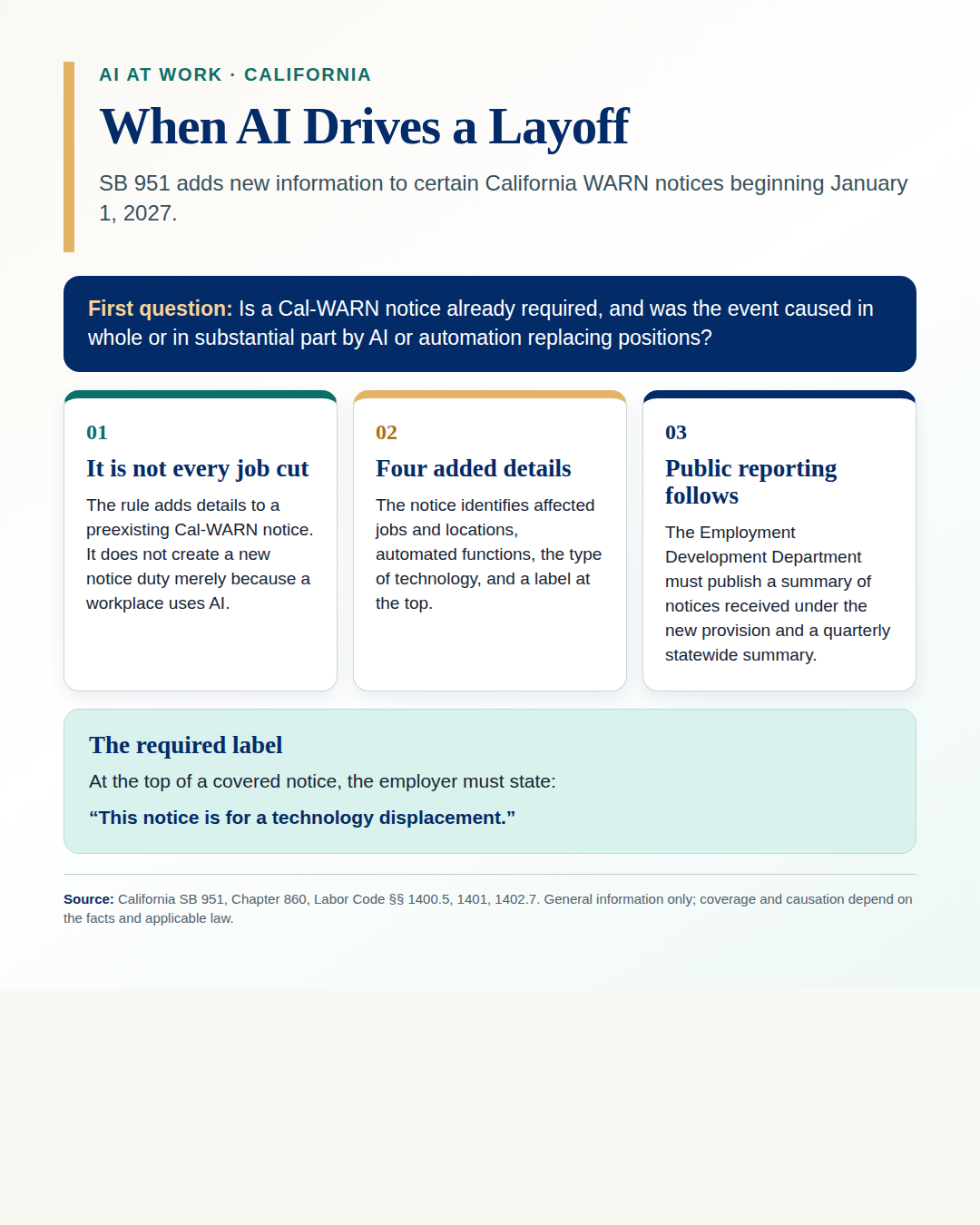
The starting point matters. SB 951 does not create a new notice requirement just because a business uses artificial intelligence or automates a task. It adds information to a Cal-WARN notice only when an employer is already required to give that notice and the mass layoff, relocation, or termination was caused in whole or in substantial part by an AI system or other automated technology replacing or automating employment positions.
Current legal analyses report that the new disclosure requirements take effect January 1, 2027. Read a current legal summary.
What Cal-WARN covers before AI enters the picture
Cal-WARN already sets the threshold. Under the statute, a covered establishment is an industrial or commercial facility that employs, or has employed within the preceding 12 months, 75 or more people. A mass layoff means a layoff of 50 or more employees during a 30-day period. The statute separately defines relocation and termination. Read Labor Code section 1400.5.
The California Employment Development Department explains that the law generally requires 60 days’ advance written notice for covered mass layoffs, closures, and relocations. It also explains that the notice goes to affected employees, the Department, the local workforce development board, and certain local officials. Read the EDD’s current WARN guide.
That structure is important because it prevents an easy but incorrect conclusion: a company does not owe a Cal-WARN notice simply because it installed AI software or reduced one role. The initial question remains whether the event and workplace are covered by Cal-WARN. SB 951 adds another question when the answer is yes.
What a covered technology-displacement notice must say
When a Cal-WARN event was caused in whole or in substantial part by AI or other automated technology replacing or automating positions, SB 951 adds four required details.
- The number, classification or occupation, and work location of layoffs substantially due to the replacement or automation.
- The job functions performed by the replaced workers that will be automated by AI or other automated technology.
- The specific category or type of AI system or other automating technology that substantially resulted in the technological displacement.
- The statement “This notice is for a technology displacement” at the top of the notice.
A Cal-WARN notice is like a weather warning. It cannot stop the storm, but it tells people where the impact is expected to fall and gives them information to prepare. SB 951 asks a covered employer to make that warning more specific when AI or automation substantially caused the event. The analogy has a limit: whether a particular notice is required depends on the statute and facts, not on the name a company gives its restructuring.
Why the extra detail matters
A general notice can tell a worker that a job is ending. A technology-displacement notice, when the law requires one, must also identify the jobs and functions the employer says are being replaced or automated and the type of technology it says substantially caused the change.
That information does not prove that the company made the right decision, and it does not decide every worker’s rights. It can, however, give workers, workforce agencies, and communities a clearer factual picture of the stated reason for a covered event.
The phrase “caused in whole or in substantial part” is important. The chaptered statute does not define “substantial part.” A company’s use of AI somewhere in its operations is therefore not the same thing as proof that AI substantially caused a particular covered workforce reduction. The timing, the workforce action, the technology, and the role it played all matter.
What becomes public over time
SB 951 directs the Employment Development Department to publish a summary of the technology-displacement notices it receives and to post a quarterly statewide summary of the reported displacements. Read Labor Code section 1401(d).
The law also directs the Department to report to the Legislature by January 1, 2028 on AI’s effects on business hiring practices. That report may include recommendations for a future public-notice rule when an employer permanently ends hiring or contracting for a position because of AI or other automation. That is a study-and-recommendations provision, not a current requirement that every employer disclose an AI-related hiring pause. Read Labor Code section 1402.7.
What workers can look for
For a California worker who receives a layoff notice, the practical question is not simply whether the employer uses AI. It is whether the notice is a covered Cal-WARN notice and whether it carries the technology-displacement statement and the added details required by SB 951.
Workers can keep lawful copies of notices, job descriptions, employer communications, and materials describing the actual job change. This article does not ask readers to upload workplace documents. If a notice raises a question about a specific job loss, an attorney can assess the relevant facts, the applicable law, and any deadlines in a private setting.
For a broader discussion of how AI can reshape access to work, read AI and the Future of Work: The New Time Divide. For an explanation of AI-assisted individual discipline and termination, read Fired by Software: Your Rights When an Algorithm Manages and Terminates Workers. Those articles address different questions and do not replace California-specific advice about SB 951.
The rule has a specific boundary
SB 951 gives California a clearer disclosure rule for a defined set of workforce events. It does not treat every business use of AI as a layoff cause. It does not make every job loss a Cal-WARN event. And it does not settle whether AI was a substantial cause in a particular situation.
Starting in 2027, however, a covered Cal-WARN notice involving technology displacement must offer more than a general explanation. It must identify the affected work and the technology the employer says substantially resulted in the displacement.
Questions addressed
1. Does every AI-related job cut require a California notice?
No. SB 951 adds details to a notice only when an employer is already required to provide Cal-WARN notice for a covered mass layoff, relocation, or termination, and the event was caused in whole or in substantial part by AI or other automated technology replacing or automating employment positions.
2. What new information must a covered notice include?
The notice must identify the affected jobs and locations, the job functions to be automated, the category or type of AI or other automating technology involved, and the statement “This notice is for a technology displacement” at the top.
3. Does a company’s use of AI prove that AI caused a layoff?
No. SB 951 applies when a covered event was caused in whole or in substantial part by AI or other automated technology replacing or automating positions. The statute does not define “substantial part,” so whether the rule applies depends on the facts and applicable law.
4. Must employers publicly disclose every AI-related hiring freeze now?
No. SB 951 directs the Employment Development Department to report to the Legislature by January 1, 2028 on AI’s effects on hiring practices and possible future notice requirements. It does not itself create a current general public-notice rule for every AI-related hiring pause.
General information only. This article does not provide legal advice or create an attorney-client relationship. SB 951 is California-specific; Cal-WARN coverage, causation, exceptions, and available remedies depend on the facts and applicable law.
Wondering how this applies to you?
Every situation is different, and deadlines can be short. A free case review helps the intake team identify time-sensitive issues.
Start your free case review